

 Drainage
How to Fix Standing Water in Your Yard in Florida
Standing water in a Florida yard is more than an inconvenience. Water that continues to collect after heavy rain can leave grass saturated, create muddy areas, contribute to erosion and make portions of a property difficult to use.
The challenge is that standing water can have several different causes. The water may be coming from the yard itself, a roof, multiple downspouts, a pool deck, neighboring properties or several sources at the same time.
That means fixing the problem starts with understanding the water — not simply installing a drain in the middle of the puddle.
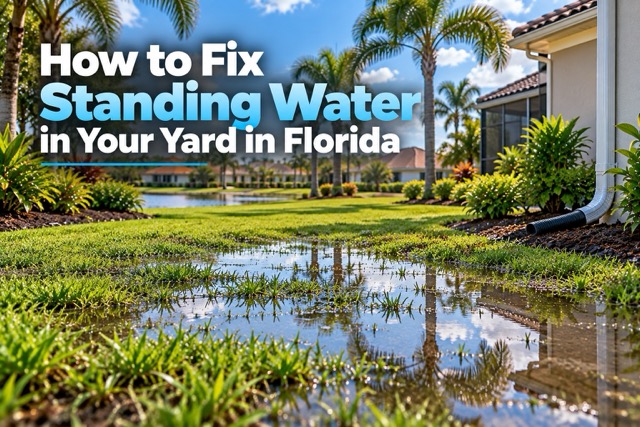
Why Is Water Standing in My Florida Yard?
Florida creates some challenging conditions for residential drainage. Heavy rainfall can place a tremendous amount of water onto a property in a relatively short period of time.
At the same time, many properties in Southwest Florida have relatively small elevation changes. Once the ground becomes saturated, additional rainfall has fewer places to go.
Standing water can result from conditions such as:
- Low areas in the yard
- Flat or poorly draining grades
- Heavy rainfall
- Saturated soil
- Roof runoff
- Downspouts discharging near the house
- Pool decks and patios
- Paver driveways
- Super gutters and screen enclosures
- Neighboring properties at higher elevations
- Existing drainage systems that cannot evacuate water efficiently
- A lack of an appropriate gravity discharge location
The puddle tells you where the water ended up. It doesn’t necessarily tell you where the drainage problem started.
Start by Understanding the Water
At Venice Drainage, we approach standing water by answering a few basic questions:
- Where is the water coming from?
- Where is it collecting?
- Why isn’t it draining?
- How much water may be reaching the area?
- Where can the water appropriately go?
- Can gravity move it there?
- If gravity can’t move it, does the water need to be pumped?
Those answers help determine what type of drainage system actually makes sense for the property.
If you’re not sure why your yard is flooding, you don’t need to diagnose the system yourself.
Learn more about our drainage assessment process →
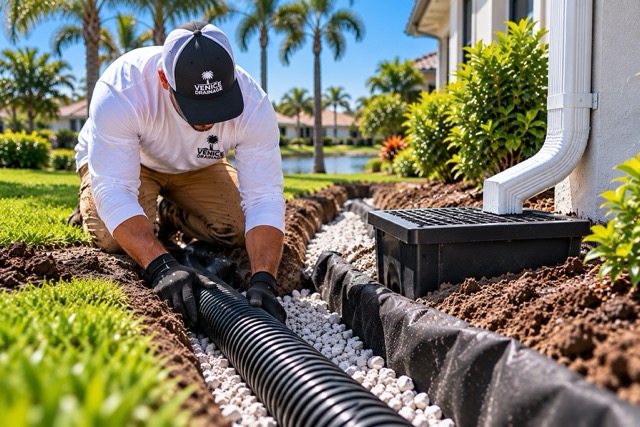
How Do You Fix Standing Water in a Florida Yard?
There isn’t one drainage system that is right for every flooded yard. The appropriate solution depends on why the water is there and what options exist for moving it.
Here are some of the most common solutions we consider.
1. Catch Basins & Yard Drains
When surface water repeatedly collects in a defined low area, a catch basin can provide a collection point for that water.
The basin is typically installed near the low point of the area and connected to underground drainage pipe.
But the basin itself doesn’t make the water disappear.
The important question is where the pipe connected to the basin will take the water.
If the property has sufficient elevation change, the water may be able to move naturally through a gravity drainage system .
2. Gravity Drainage
Whenever practical, gravity can be one of the simplest ways to move water.
The concept is straightforward:
Point A → Underground Pipe → Point B
Water is collected at the problem area and travels through underground pipe toward an appropriate lower discharge point.
The key is having enough elevation difference to create positive flow. This is why measuring property elevations can be important when determining whether gravity drainage is practical.
Venice Drainage uses laser leveling technology when appropriate to evaluate elevations rather than relying solely on what the property appears to be doing visually.
3. French Drains for Saturated Areas
A French drain serves a different purpose than a surface catch basin.
Instead of primarily collecting water flowing across the surface, a French drain can help collect water within saturated soil.
A typical system uses perforated drainage pipe installed within a properly constructed aggregate trench.
French drains can be useful in persistently wet areas, along certain side yards and in other locations where subsurface water is contributing to the problem.
Don’t Ignore the Water Coming From Your Roof
Sometimes the lawn isn’t the primary source of the drainage problem.
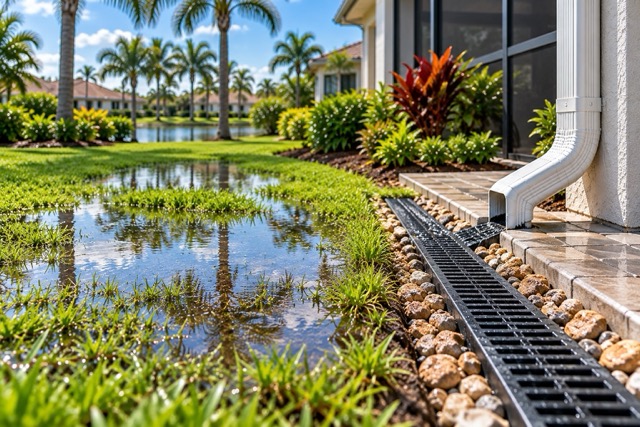
A roof can collect a significant amount of rainfall and concentrate that water into a handful of downspouts.
If those downspouts terminate next to the house or discharge into an already low area, roof runoff may significantly increase the amount of water collecting in the yard.
In these situations, extending the downspouts underground and routing the water toward an appropriate discharge location may be part of the solution.
Learn about underground downspout drainage →
Pool Decks, Patios & Pavers Create Runoff Too
Hard surfaces don’t absorb rainfall like soil and landscaping can.
Pool decks, patios, walkways and paver driveways can therefore send additional water toward surrounding low areas.
Depending on the property, a channel or deco drain may be used to intercept water moving across a hard surface before it reaches another part of the property.
Learn about deco and channel drains →
Water From Neighboring Properties Can Be Part of the Problem
The source of the water may even be outside your property.
If an adjacent property sits at a higher elevation, stormwater may move toward the lower property during heavy rainfall.
That doesn’t automatically determine what drainage system should be installed, but it is an important condition to identify when evaluating why a particular area repeatedly floods.
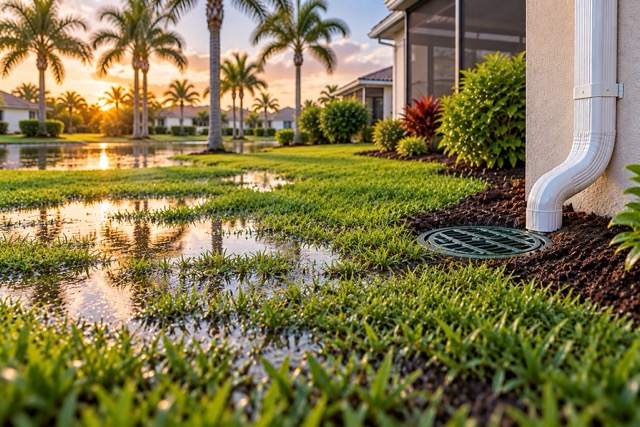
What If the Yard Doesn’t Have Enough Slope?
This is where Florida properties can become more challenging.
You may know exactly where the water needs to be collected but still have no lower location where it can naturally drain.
If sufficient gravity fall isn’t available, a landscape sump pump may be considered.
In a pumped system, water is collected into an appropriate basin and then mechanically moved toward the designed discharge location.
The decision between gravity and a pump should be based on the actual elevations and conditions of the property rather than assuming every yard requires one system or the other.
Drainage Capacity Matters During Florida Rainstorms
Installing a drain doesn’t automatically mean the drainage problem has been solved.
The system also needs to be capable of handling the water being directed into it.
Depending on the property, that water may come from:
Water Collection Sources
- Roof areas
- Multiple downspouts
- Super gutters
- Pool cages
- Pool decks
- Patios
- Paver driveways
Property Runoff Sources
- Low yard areas
- Catch basins
- Channel drains
- Landscape runoff
- Saturated ground
- Neighboring properties
- Other connected drainage systems
If several sources are connected to the same underground drainage line, the amount of water entering that line can increase quickly during a heavy storm.
A drainage system needs to do two things: collect the water and move it away efficiently.
Pipe diameter, slope, pipe characteristics, collection points and discharge conditions all affect how the overall system performs.
Common Mistakes When Trying to Fix Standing Water
Drainage problems sometimes become more complicated because the visible symptom is addressed without identifying the actual cause.
Installing a Drain Without a Discharge Plan
A catch basin can collect water, but that water still needs somewhere appropriate to go.
Assuming Every Wet Area Needs a French Drain
Surface runoff, roof runoff and saturated soil are different drainage problems and may require different solutions.
Ignoring Roof Runoff
A large roof can concentrate rainfall through a relatively small number of downspouts and dramatically change conditions around a home.
Guessing at the Grade
Small elevation differences can matter. Measuring grade can help determine whether the proposed gravity route actually provides positive flow.
When Should You Have a Drainage Assessment?
An occasional puddle immediately after an unusually heavy storm does not necessarily mean a property requires a major drainage system.
But an assessment may make sense when you repeatedly experience:
- Standing water after normal Florida rainstorms
- A backyard that remains saturated
- Recurring side-yard flooding
- Water collecting near the house
- Downspouts creating washout or puddling
- Water crossing patios, pool decks or walkways
- Erosion around pavers or landscaped areas
- Existing drains that don’t seem to keep up
- Water entering from surrounding properties
You don’t need to know whether you need a French drain, catch basin, gravity line, channel drain or sump pump before contacting a drainage contractor.
The first step is understanding the problem.
Standing Water Solutions From Venice Drainage
Venice Drainage provides residential and commercial drainage services throughout Venice and surrounding Southwest Florida communities.
Our approach is based on understanding the property before determining the system.
We evaluate where water is coming from, where it collects, available elevation, potential discharge locations and the different sources of water affecting the property.
Depending on the conditions, a solution may involve one drainage method or several components working together.
Our services include yard drainage, gravity drainage, catch basins, French drains, underground downspout drainage, channel drains, landscape sump pumps, new construction drainage and commercial drainage.
Frequently Asked Questions About Standing Water in Florida Yards
Why does my Florida yard hold water after it rains?
Common causes include low areas, limited grade, saturated soil, roof runoff, hard surfaces, neighboring runoff or insufficient drainage. Several of these conditions may be contributing at the same time.
What is the best drain for standing water in a yard?
There isn’t one best drain for every yard. A surface low point may benefit from a catch basin, saturated soil may call for a French drain, roof runoff may require downspout drainage, and a property without adequate gravity fall may require a pumped system.
Will a French drain fix standing water?
A French drain can be useful when saturated soil and subsurface water are contributing to the problem. Concentrated surface water may be better collected using a catch basin or another surface drainage method.
Can I drain standing water using gravity?
Potentially. Gravity drainage requires an appropriate lower discharge location and enough elevation difference along the pipe route to create positive flow.
What if my backyard is too flat to drain?
If there isn’t sufficient elevation for a practical gravity system, a landscape sump pump may be considered to mechanically move collected water toward the designed discharge location.
Can my downspouts be causing the standing water?
Yes. Roof runoff is concentrated by gutters and downspouts. If downspouts discharge into low or poorly drained areas, they can add a significant amount of water during heavy rainfall.
How do I know which drainage system my yard needs?
Start by identifying where the water originates, where it collects, why it cannot leave naturally and where it could appropriately be discharged. A drainage assessment can help determine which solution fits those conditions.
Need Help With Standing Water in Your Yard?
If your yard repeatedly floods or holds water after Florida rainstorms, show us what’s happening. You don’t need to determine which drainage system you need before contacting us.
We’ll start with the property, the water and the elevations — then determine the appropriate drainage approach.
