

 Drainage
Why Is Water Pooling in My Yard After Heavy Rain?
If you notice water pooling in your yard after heavy rain, the puddle you’re looking at may only be the final destination of the water — not the actual source of the drainage problem.
This is particularly important in Florida, where intense rain can place a large amount of water onto roofs, lawns, pool decks, patios and driveways in a relatively short period of time.
That water follows the property elevations until it reaches somewhere it can no longer continue moving. That’s often where the standing water appears.

Where you see the puddle isn’t necessarily where the drainage problem begins.
Why Does My Yard Hold Water After It Rains?
At the simplest level, standing water occurs when water enters an area faster than it can leave.
But determining why that is happening requires looking beyond the wet spot itself.
Your yard may receive water from several sources simultaneously:
- Rain falling directly onto the lawn
- Roof runoff concentrated through gutters and downspouts
- Pool decks and screened enclosures
- Patios and walkways
- Paver driveways
- Super gutters
- Higher neighboring properties
- Other portions of your own property
Once you understand where the water originates, you can begin figuring out why it is collecting.
How We Look at a Yard Drainage Problem
Instead of starting by asking which drain should be installed, it helps to evaluate the entire path the water is taking.
- Source: Where is the water coming from?
- Collection: Where is it accumulating?
- Elevation: Why can’t the water continue moving naturally?
- Capacity: How much water may need to be handled?
- Discharge: Where can that water appropriately go?
Those questions help determine whether the property needs surface drainage, subsurface drainage, roof runoff management, gravity drainage, pumping or a combination of solutions.
Common Causes of Water Pooling in Florida Yards
1. Your Yard Has a Low Area
Water naturally follows elevation. If part of your yard sits lower than the surrounding property, runoff may repeatedly travel toward that area.
Even a relatively small elevation difference can affect where stormwater moves.
The low area may be obvious, but sometimes it is difficult to see without actually measuring elevations.
2. The Ground Is Already Saturated
Florida soil can reach a point where additional rainfall cannot infiltrate quickly enough.
Once the ground becomes saturated, additional water can remain on the surface or begin moving toward lower areas of the property.
This is one reason a yard may appear to drain adequately during a smaller storm but develop significant standing water after prolonged or heavy rain.
3. Your Roof Is Sending Water Into the Yard
Your roof collects rainfall across a large surface and funnels that water through gutters and downspouts.
Instead of rainfall being distributed across the entire roof footprint, the gutter system can concentrate it into only a few discharge locations.
If one of those downspouts terminates next to the house or in a low section of lawn, it may contribute substantially to the water pooling there.

Downspouts Can Move the Problem Somewhere Else
A functioning gutter doesn’t necessarily mean the property has a complete roof drainage solution.
The gutter collects the roof water. The downspout brings it to ground level. The next question is:
Where does the water go after it leaves the downspout?
If the answer is simply “onto the lawn,” the water may travel toward the same low area that already receives rainfall from the surrounding property.
In some situations, underground downspout drainage can redirect roof runoff toward an appropriate discharge location rather than allowing it to collect near the house.
4. Pool Decks, Patios and Pavers Add More Runoff
Hard surfaces behave differently from lawns and landscaped areas because water cannot readily soak through them.
Rain falling onto a pool deck, patio, walkway or driveway therefore has to travel somewhere else.
Depending on the elevations, that water may flow directly into the lawn.
Properties with pool cages may also have large roof or super-gutter areas that concentrate additional water into the drainage system.
For hardscape runoff, a deco or channel drain may sometimes be part of the drainage design.
5. Water May Be Coming From a Neighboring Property
Not every drainage problem begins on your property.
If a neighboring yard sits higher, stormwater may follow the natural grade toward your property during heavy rainfall.
This can be especially noticeable when the receiving yard contains a lower area where that runoff combines with water already falling on the property.
Identifying outside runoff is important because the drainage system may need to account for more water than your own property produces.
6. The Yard Doesn’t Have Enough Positive Fall
Water does not need much encouragement to move downhill, but it still needs a lower destination.
A property can appear relatively flat while actually containing small high and low areas that control where stormwater travels.
This is why visual inspection alone may not provide the complete picture.

Why Measuring Yard Elevations Matters
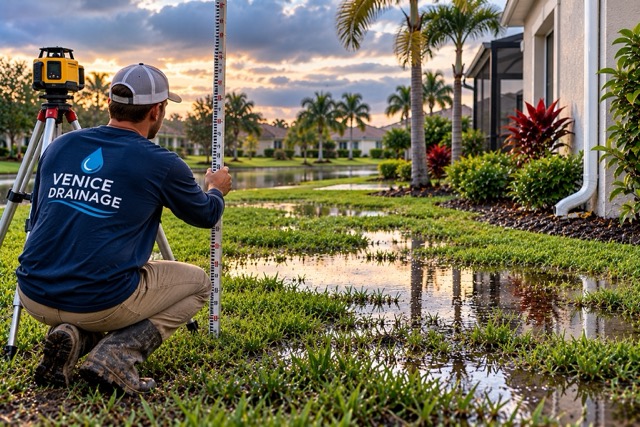
One of the most important questions in drainage is whether there is enough elevation difference to move the water naturally.
At Venice Drainage, laser leveling technology can be used when appropriate to evaluate elevations across the property.
That helps identify:
- Where the true low areas are
- Where water is naturally trying to travel
- Potential drainage routes
- Whether positive fall exists
- Possible discharge elevations
- Whether gravity drainage is practical
Rather than simply guessing which direction appears downhill, measurements can help determine whether a proposed drainage route actually works.
Learn more about yard and gravity drainage in Venice .
7. An Existing Drainage System May Not Have Enough Capacity
Sometimes the property already has drains, but water still pools during heavy rain.
That does not necessarily mean the collection point itself is the problem. The overall system has to move the incoming water efficiently.
Several downspouts, a large roof, pool deck, super gutter, yard drains and other runoff sources may all be contributing water to the same drainage line.
Pipe diameter, slope, pipe characteristics, collection points and discharge conditions all influence the performance of the system.
8. Existing Drains May Be Blocked or Poorly Positioned
Leaves, soil, roots, debris or sediment can interfere with drainage components over time.
A drain can also be functioning properly but simply be installed in the wrong location relative to where the water actually collects.
That is another reason diagnosing the property should come before assuming a particular component needs to be replaced.
Is Standing Water After Heavy Rain Always a Drainage Problem?
Not necessarily.
An unusually intense Florida storm can temporarily overwhelm the natural infiltration capacity of a property. A small amount of water immediately after extreme rainfall does not automatically mean an extensive drainage system is required.
What matters is the pattern.
Pay attention to questions such as:
- Does the same area flood repeatedly?
- Does the water remain long after surrounding areas have drained?
- Does the problem happen during ordinary summer rain?
- Is the wet area getting larger?
- Does water collect close to the house?
- Are downspouts discharging into the flooded area?
- Is runoff visibly entering from another property?
- Is erosion or washout developing?
Recurring patterns provide useful clues about what is happening.
What Type of Drainage System Fixes Water Pooling?
The correct solution depends on what the diagnosis shows.
Catch Basins
Useful for collecting concentrated surface water from defined low areas and directing it into underground piping.
Gravity Drainage
Moves collected water naturally from a higher collection point toward an appropriate lower discharge point when sufficient elevation is available.
French Drains
Can help collect subsurface water in areas where saturated soil is part of the drainage problem.
Downspout Drainage
Moves concentrated roof runoff underground instead of allowing downspouts to discharge directly into problem areas.
Channel & Deco Drains
Can intercept runoff moving across pavers, pool decks, patios, driveways and other hard surfaces.
Landscape Sump Pumps
May be considered when water can be collected but the property does not provide enough elevation for a practical gravity discharge.
The goal isn’t to install the most drainage components. It’s to identify the simplest effective way to collect the problem water and move it to an appropriate location.
How Do I Find Out Why My Yard Is Flooding?
You don’t need to know which drainage system you need before contacting Venice Drainage.
A drainage assessment is designed to help answer the questions that come first:
- Where is the water coming from?
- Where is it collecting?
- Why is it collecting there?
- What elevations are available?
- Where can the water appropriately be moved?
- Can gravity do the work?
- How much water does the system need to handle?
From there, the drainage approach can be designed around the property instead of trying to force the property into a predetermined solution.
What If I Already Know I Have Standing Water?
If you’ve already identified the problem and want to understand the different ways it can be corrected, read our guide:
How to Fix Standing Water in Your Yard in Florida →
You can also explore all of our drainage services in Venice, FL to compare the different systems we install.
Frequently Asked Questions
Why does my backyard flood every time it rains?
Recurring backyard flooding can result from low elevations, saturated soil, roof runoff, neighboring runoff, hardscape runoff or insufficient drainage. The repeated pattern usually indicates that water is consistently reaching an area faster than it can leave.
Why does water pool in one spot in my yard?
That location is likely lower than at least some of the surrounding ground, or water is being concentrated there from another source. Measuring elevations and identifying runoff sources can help determine why that specific area receives the water.
Can downspouts cause my yard to flood?
Yes. Gutters collect rainfall from a large roof area and concentrate it through a small number of downspouts. If a downspout terminates near a low area, that roof runoff can contribute significantly to standing water.
Can water from my neighbor cause flooding in my yard?
Water naturally follows elevation. If an adjacent property is higher, stormwater may move toward a lower neighboring property during rainfall. That runoff should be considered when evaluating the overall drainage problem.
Why does my yard only flood during very heavy rain?
Heavy rainfall can saturate the ground and create runoff faster than the property or existing drainage system can handle it. If flooding repeatedly occurs during larger storms, drainage capacity and available discharge routes may need to be evaluated.
How do you determine which way a yard should drain?
Property elevations can be measured to identify high points, low points and potential routes with positive fall. These measurements can help determine whether water can be moved using gravity.
Do I need a French drain for water pooling in my yard?
Not necessarily. French drains are useful for certain subsurface and saturated-soil conditions, while concentrated surface water may be better handled with catch basins, downspout drainage, channel drains or another system.
Not Sure Why Your Yard Is Holding Water?
You don’t have to determine whether you need a French drain, catch basin, gravity drain, downspout system or landscape sump pump yourself.
We’ll start by looking at where the water comes from, where it collects, the property elevations and where that water can appropriately go.
