- 509 Cypress Ave, Venice FL 34285
- Mon to Friday: 8:00 am - 6:00 pm
Water flowing across a driveway, pooling near a garage, or collecting on a pool deck usually requires a different drainage solution than water sitting in a lawn. Hardscape surfaces don’t absorb much rainfall, so stormwater can move quickly across pavers, concrete, patios, and pool decks.
Venice Drainage provides professional deco drain and channel drain installation in Venice, FL and throughout Sarasota County and surrounding Southwest Florida communities. These linear drainage systems are designed to intercept surface water across hardscape areas and redirect it into an underground drainage system.
Whether water is entering your garage, collecting across a paver driveway, sitting on a patio, or causing drainage problems around a pool deck, we’ll evaluate how the water moves across the property and determine the best location for the drain.
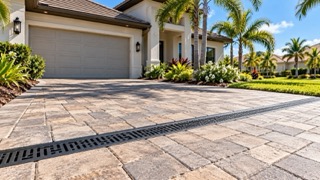
A deco drain is a long, narrow surface drainage system installed within or alongside a hardscape.
You may also hear similar drainage systems called:
The terminology varies, but the basic purpose is the same: intercept surface water across a wider area and move it into a drainage system.
Instead of relying on a single small catch basin, a channel drain creates a long collection point across the path of moving water.
A channel drain consists of a narrow drainage channel covered by a removable grate.
As stormwater moves across the surface, it falls through the grate and enters the channel below.
The collected water is then transported through underground drainage piping toward an appropriate discharge location.
A properly designed system generally includes:
The location and elevation of the drain are critical.
If water naturally flows toward a garage, for example, the channel drain should be positioned where it can intercept that water before it reaches the garage entrance.
Deco and channel drains are particularly effective for water moving across hard surfaces.
Common applications include:
The goal is to intercept the water before it reaches the area where it causes a problem.
Driveways can collect and transport a surprising amount of stormwater.
Pavers and concrete absorb far less water than a lawn or landscape bed. Once rainfall exceeds the small amount of water that can enter joints or surrounding soil, runoff begins moving across the surface.
The slope of the driveway determines where that water goes.
If the driveway pitches toward the garage, home, or another low area, stormwater may repeatedly collect in the same location.
A channel drain installed across the path of that water can intercept runoff before it reaches the problem area.
One common application is installing a linear drain across the driveway near the garage entrance.
This can be useful when:
The drain creates a collection line across the driveway rather than relying on water to reach one small inlet.
Paver driveways are extremely common throughout Venice and Southwest Florida.
Installing drainage within pavers requires careful attention to both the drain and the surrounding hardscape.
The channel must be installed at the correct elevation so water enters the grate instead of passing around it.
The surrounding pavers also need to remain properly supported.
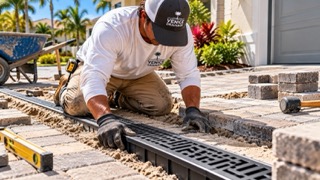
Before installing the drain, we evaluate where the water originates and the direction it travels across the surface.
We look at:
A channel drain works best when it crosses the natural path of the water.
The exact location depends on what we’re trying to protect and where the runoff is coming from.
Depending on the surface, installation may require removing pavers or cutting into an existing hardscape.
The installation area is prepared so the drainage channel can sit at the correct elevation.
The drainage channel is positioned so water can enter the grate while the surrounding surface remains functional.
Correct elevation is particularly important. A drain installed too high may cause water to flow around it instead of into it.
The collected water must then be transported away from the channel through drainage piping.
As with any drainage system, the outlet is just as important as the inlet.
After the drainage system is connected, the surrounding pavers or hardscape can be restored around the drain.
Pool decks and outdoor living spaces present another common drainage challenge.
These areas may receive water from:
Because the surface is mostly hardscape, water can collect quickly if the deck doesn’t have an effective drainage path.
Linear drains can collect water along a larger section of the pool deck and transport it away from the outdoor living area.
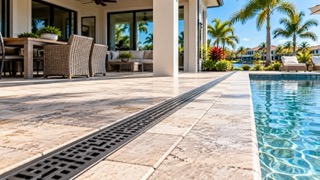
Florida homes are built around outdoor living.
Covered patios, lanais, pool decks, and outdoor kitchens create large areas where effective drainage matters.
Standing water in these areas can make the space difficult to use and can carry dirt, mulch, and landscape debris across finished surfaces.
A properly located channel drain can intercept water between:
A deco drain and catch basin both collect surface water, but they collect it differently.
A catch basin collects water at one concentrated point.
A channel drain collects water across a longer linear area.
If water is collecting in one low spot in the lawn, a catch basin may be appropriate.
If water is flowing across the entire width of a driveway toward a garage, a channel drain may provide a better collection point.
Some drainage systems use both.
These systems solve very different drainage problems.
A deco or channel drain collects water moving across the surface.
A French drain primarily collects water from saturated soil below the surface.
If your paver driveway floods during a storm but the surrounding lawn drains normally afterward, a channel drain may be more appropriate.
If your lawn remains soggy for days after the rain stops, subsurface drainage may also be needed.
Learn more about our French drain installation in Venice, FL.
Roof runoff should also be considered when diagnosing hardscape drainage problems.
A downspout that releases water onto or near a driveway can send a significant amount of stormwater across the pavers.
Installing a channel drain may capture that water, but it can sometimes make more sense to control the source as well.
Underground downspout drainage can capture roof runoff directly at the downspout and transport it away before it crosses the hardscape.
Properties with multiple sources of runoff may benefit from both systems.
Collecting water is only half of the drainage equation.
The collected water still needs somewhere to go.
When the property has adequate elevation, gravity can move water through underground pipe toward the discharge location.
However, many properties throughout Venice and Sarasota County are extremely flat.
If there isn’t enough fall to move water effectively, the channel drain may need to feed into a basin containing a landscape sump pump.
The pump can then move collected stormwater to an appropriate discharge point.
Installing a channel drain in the wrong location can significantly reduce its effectiveness.
Water follows elevation.
A drain needs to be positioned where water naturally travels or where the surrounding hardscape can direct water toward it.
That’s why we consider:
The goal is to intercept the water before it reaches the problem area.
Yes. In many situations, a channel drain can be installed within an existing paver driveway.
Installation typically involves carefully removing the necessary pavers, preparing the drainage channel, connecting the underground pipe, and restoring the pavers around the new drain.
The feasibility and complexity depend on the existing driveway, base material, elevations, access, and where the collected water needs to go.
A properly designed drainage system can help manage substantial surface runoff, but capacity matters.
The amount of water entering a channel drain depends on:
A drain is only as effective as the system carrying water away from it.
Installing a large channel with an undersized or poorly routed outlet pipe can still result in drainage problems during heavy storms.
The cost of a deco or channel drain installation varies based on the specific application.
Factors affecting pricing include:
A short residential patio drain will be very different from a channel drain running across a wide driveway with extensive underground piping.
An on-site evaluation allows the drainage layout and installation requirements to be determined before providing an estimate.
Not every property can be solved with one drain.
A complete system might include:
For example, a driveway channel drain may collect hardscape runoff while underground downspout drainage handles roof water and a French drain manages saturated soil beside the driveway.
All three systems address different sources of water while working together as part of one drainage plan.
Linear drainage systems aren’t limited to residential properties.
Channel and trench drains can also be used in commercial environments where large hardscape areas generate significant runoff.
Applications may include:
Commercial drainage design depends heavily on expected water volume, traffic loads, surface materials, and the available stormwater system.
A channel drain is only one part of a drainage system.
We look beyond the grate itself to understand how the water reaches the drain and where it will go afterward.
Venice Drainage provides solutions including:
We evaluate the drainage problem first and then determine which system—or combination of systems—best fits the property.
Venice Drainage provides deco drain, channel drain, and hardscape drainage installation throughout Southwest Florida, including:
If your property is nearby but your community isn’t listed, contact us to see whether you’re within our service area.
A deco drain is a linear surface drainage system used to collect water across hardscape areas such as driveways, patios, pool decks, and walkways. Water enters through a grate and is carried away through a connected drainage system.
The terms are often used interchangeably for linear drainage systems. Specific products and construction methods can vary, but both are designed to collect surface runoff along a long, narrow drainage channel.
Yes, in many cases. Existing pavers can be removed along the drainage route, the channel and underground piping can be installed, and the surrounding pavers can then be restored.
The correct location depends on the driveway’s slope and where the water is causing problems. Channel drains are commonly installed across the path of runoff, including near garage entrances or other low areas.
Yes. Linear drainage can be used around pool decks, patios, and lanais to collect surface water and transport it away from the outdoor living area.
Neither is universally better. Channel drains collect water across a long linear area, while catch basins collect water at specific low points. The best choice depends on how water moves across the property.
No. A channel drain collects surface water through a visible grate. A French drain generally collects water from saturated soil through gravel and perforated underground pipe.
Yes. The water collected by the channel typically exits through underground drainage piping that transports it toward an appropriate discharge point.
Not always. If sufficient elevation exists, the system may drain by gravity. A landscape sump pump may be necessary when the property is too flat for gravity drainage to work effectively.
A properly located channel drain can help intercept water moving across a driveway toward a garage. Effectiveness depends on the driveway elevations, runoff volume, drain capacity, and the ability to move the collected water away.
If water is flowing across your driveway, collecting near your garage, or sitting on your pool deck or patio, a linear drainage system may provide the collection point your property is missing.
Venice Drainage can evaluate the hardscape elevations, identify where the runoff originates, determine the best drain location, and design a system to transport the collected water away.
The solution may be a deco drain alone—or a larger system incorporating underground downspout drainage, catch basins, French drains, or a landscape sump pump.
Contact Venice Drainage today to schedule an on-site deco drain or channel drain estimate in Venice, Sarasota, or surrounding Southwest Florida communities.