- 509 Cypress Ave, Venice FL 34285
- Mon to Friday: 8:00 am - 6:00 pm
When a Florida thunderstorm hits, your roof can collect hundreds or even thousands of gallons of rainwater. Gutters help control that water—but if your downspouts simply dump it beside the house, the drainage problem has only been moved from the roof to the ground.
Venice Drainage provides professional downspout drainage installation in Venice, FL and throughout Sarasota County and surrounding Southwest Florida communities. We install underground drainage systems designed to carry concentrated roof runoff away from homes, landscaping, walkways, and problem areas in the yard.
If your downspouts are contributing to standing water, soggy landscaping, erosion, or recurring side-yard flooding, an underground downspout drainage system may be one of the most effective ways to control the source of the problem.

Gutters are designed to collect rainwater from the roof and direct it into downspouts. The problem begins when those downspouts terminate only a few inches or feet from the house.
Instead of allowing the water to spread across the property naturally, the roof concentrates a large amount of rainfall into several specific locations.
That concentrated runoff can contribute to:
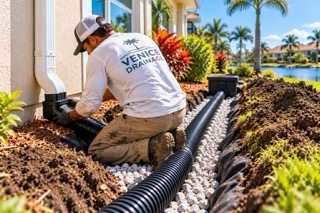
Underground downspout drainage captures that water at the downspout and transports it through buried drainage pipe toward an appropriate discharge location.
The basic concept is straightforward.
Instead of allowing the downspout to discharge directly onto the lawn or landscape bed, it connects to an underground drainage system.
The system generally includes:
The roof runoff enters the buried pipe and is transported away from the problem area.
The important part isn’t simply getting the water underground. The system needs to move that water somewhere appropriate.
Every downspout drainage project should answer two questions:
Where is the water coming from?
Where are we safely going to send it?
Downspout drainage is particularly important in Southwest Florida because of the amount and intensity of rainfall we can receive.
A home’s roof acts like a giant collection surface.
One inch of rain falling on 1,000 square feet of roof produces approximately 623 gallons of water.
That means a 2,000-square-foot roof can collect roughly 1,246 gallons from only one inch of rainfall.
During a heavy Florida storm, several inches of rain can fall in a relatively short period.
Without effective downspout drainage, much of that water may be released directly beside the home.
Venice and many surrounding Sarasota County communities have relatively flat lots.
Water doesn’t need a dramatic low spot to become trapped. A difference of only a few inches in elevation can determine whether roof runoff moves away from a house or remains in the lawn.
Side yards are especially vulnerable because they often contain:
Add concentrated water from one or more downspouts and the area can quickly become saturated.
Your downspouts may be contributing to a larger drainage problem if you notice:
Moving the discharge point farther away from the home can often eliminate one of the largest concentrated sources of water entering the problem area.
We first determine whether the roof runoff is actually contributing to the drainage problem.
That includes looking at:
We determine how the underground pipe can move water away from the home while working around existing landscaping, irrigation, utilities, hardscapes, and other site conditions.
The existing gutter downspout is connected to the underground drainage system using an appropriate adapter or inlet.
For roof runoff, we typically want to transport water rather than collect groundwater along the entire pipe route.
That means downspout systems generally use solid drainage pipe.
The final destination depends on the property and available elevations.
The important thing is that the system doesn’t simply relocate the drainage problem from one part of the yard to another.
Once the system is installed and connected, disturbed areas can be restored based on the surrounding lawn and landscaping.
Above-ground downspout extensions can be an inexpensive way to move water several feet away from a home.
In some situations, that’s all that is needed.
However, extensions can also:
An underground downspout drainage system provides a more permanent way to transport the water farther across the property without leaving drainage pipe lying on top of the lawn.
Downspout drainage and French drains serve different purposes.
Downspout drainage transports roof runoff.
French drains collect water from saturated soil.
Because roof runoff can arrive very quickly during a thunderstorm, downspouts are generally routed through solid drainage pipe rather than simply dumping directly into a perforated French drain.
If the surrounding lawn is also saturated, the property may benefit from both systems.
Learn more about our French drain installation in Venice, FL.
One of the most common applications for underground downspout drainage is a narrow side yard.
Imagine two neighboring Florida homes with roof runoff entering the same relatively flat strip of grass.
Several downspouts may release water into an area only a few feet wide.
Once the soil becomes saturated, additional rainfall has nowhere to go.
A complete side-yard drainage solution may include:
Controlling the roof runoff first can significantly reduce the amount of water entering the lawn.
Downspout systems can also be combined with surface drainage.
A catch basin collects water that is already moving across the surface of the lawn.
The downspout connection captures roof runoff before it reaches the lawn.
Using both can help manage two different sources of water within the same drainage system.

Roof runoff can also contribute to drainage problems around hardscapes.
Water may move toward:
In these situations, underground downspout drainage can control the roof water while a deco drain or channel drain intercepts water moving across the hardscape.
Addressing both sources is often more effective than attempting to solve everything with a single drain.
Gravity drainage works when there is sufficient elevation difference between where the water enters the system and where it needs to discharge.
Florida’s flat terrain can make that difficult.
If there isn’t enough natural fall, the drainage system may need to collect water in a basin and mechanically move it to a suitable discharge point.
A landscape sump pump can be incorporated into a drainage system when gravity alone isn’t sufficient.
One of the biggest mistakes in drainage work is focusing on only one symptom.
For example, a homeowner may have standing water in the backyard and assume a French drain is automatically required.
But if two large downspouts are dumping roof runoff into that exact area, controlling the downspouts may be an important part of the solution.
A complete drainage system may combine:
The right combination depends on how water actually moves across the property.
The cost of underground downspout drainage varies significantly from property to property.
Important cost factors include:
A short, straightforward downspout extension system will naturally cost less than a complete property drainage system connecting several downspouts, catch basins, and a pump.
The best way to determine the cost is to evaluate the property and design the system around the actual drainage problem.
This is one of the most important questions in any downspout drainage project.
The goal isn’t simply to bury the pipe.
The collected water must ultimately reach an appropriate location based on the property’s elevations, drainage layout, and site conditions.
A properly planned system should avoid:
The available discharge options vary by property, which is why an on-site evaluation is important.
Yes—when roof runoff is contributing to the flooding.
Consider how much water a large roof can collect during several inches of rain.
Redirecting that water before it reaches an already saturated lawn can substantially reduce the amount of stormwater entering the problem area.
However, downspout drainage won’t solve every yard flooding problem by itself.
Surface runoff, low elevations, groundwater, neighboring properties, and poor grading may also need to be addressed.
We don’t approach drainage by simply installing pipe wherever water happens to be visible.
We look at the property as a complete system.
That means identifying:
Venice Drainage provides solutions including:
Venice Drainage provides underground downspout drainage and yard drainage solutions throughout Southwest Florida, including:
If you’re located nearby but don’t see your community listed, contact us to see whether your property is within our service area.
Yes. Downspouts can be connected to underground drainage pipe to transport roof runoff away from the home and other problem areas.
There isn’t one distance that works for every property. The correct distance depends on property elevations, the location of low areas, available discharge points, surrounding landscaping, and how water moves across the site.
Downspout drainage typically uses solid pipe because the goal is to transport concentrated roof runoff without releasing that water along the pipe route. Perforated pipe is commonly associated with French drains designed to collect groundwater from surrounding soil.
Multiple downspouts can sometimes be incorporated into the same drainage system, but pipe capacity, roof area, rainfall volume, system layout, and the discharge location need to be considered.
Downspouts and catch basins can be incorporated into the same overall drainage design. Downspouts manage concentrated roof runoff while catch basins collect surface water.
Any drainage system can experience blockages if debris enters the pipe. Keeping gutters clear, using appropriate connections, and designing the system with maintenance in mind can help reduce problems.
If the primary problem is roof runoff, downspout drainage may be the appropriate solution. If the soil remains saturated because of groundwater or poor subsurface drainage, a French drain may be more appropriate. Some properties need both.
Not always. When adequate elevation exists, gravity may transport the water. A landscape sump pump may be necessary when the property is too flat or the required discharge point is higher than the collection area.
Yes, particularly when one or more downspouts are releasing roof runoff into the side yard. Other drainage methods may also be required if the area has surface runoff, poor grading, or saturated soil.
Often, yes. The exact route depends on access, existing plants, irrigation, utilities, hardscapes, and the required drainage outlet.
If your gutters are working but your downspouts are dumping hundreds of gallons of stormwater directly into your landscaping or lawn, the drainage system isn’t finished yet.
Venice Drainage can evaluate your roof runoff, property elevations, existing drainage problems, and potential discharge locations to determine the best way to move that water away from problem areas.
The solution may be underground downspout drainage alone—or a complete system incorporating catch basins, French drains, channel drains, or a landscape sump pump.
Contact Venice Drainage today to schedule an on-site downspout drainage estimate in Venice, Sarasota, or surrounding Southwest Florida communities.