- 509 Cypress Ave, Venice FL 34285
- Mon to Friday: 8:00 am - 6:00 pm
Sometimes the biggest challenge with a drainage problem isn’t collecting the water—it’s finding a way to move it somewhere else.
That’s especially common in Venice and Southwest Florida, where extremely flat properties can make gravity drainage difficult or impossible. French drains, catch basins, downspout drainage, and channel drains can all collect water, but those systems still need somewhere for the water to go.
Venice Drainage provides professional landscape sump pump installation in Venice, FL and throughout Sarasota County and surrounding Southwest Florida communities. Outdoor sump pump systems can collect stormwater in an underground basin and mechanically move it to an appropriate discharge location when gravity alone isn’t sufficient.
If your yard repeatedly floods, stays saturated after storms, or doesn’t have enough elevation to drain naturally, a landscape sump pump may be an important part of the solution.

A landscape sump pump is an outdoor pumping system designed to remove collected stormwater from low areas of a property.
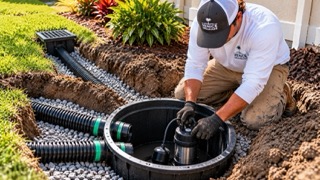
The system typically includes an underground basin installed at a strategic elevation.
Water from other drainage components flows into the basin. When the water reaches a predetermined level, a float activates the pump.
The pump then pushes the collected water through a discharge line toward an appropriate outlet.
A typical landscape sump pump system may include:
The exact design depends on how much water needs to be moved, where the water originates, and where it can safely discharge.
Most drainage systems work best when water can move downhill naturally.
But what happens when there is no downhill?
That is where a landscape sump pump becomes useful.
A yard sump pump may be appropriate when:
Instead of relying entirely on elevation, the pump provides the mechanical force necessary to move the water.
Southwest Florida presents unique drainage conditions that can make pumping systems particularly useful.
Many properties throughout Venice, Sarasota County, Englewood, North Port, and surrounding areas have very little natural elevation change.
A drainage pipe requires an appropriate relationship between the collection point and the discharge point.
If the outlet isn’t lower than the inlet, gravity may not be able to move the water effectively.
Florida thunderstorms can produce large amounts of water in a short period.
Low areas that normally remain dry can quickly fill during intense rainfall.
During extended rainy periods, the soil may already be saturated before another storm arrives.
When the ground can’t absorb additional water efficiently, runoff and standing water can increase dramatically.
Some homes have yards that are lower than the front of the property or surrounding streets.
In those situations, simply installing underground drainage pipe may not be enough.
The collected water may need to be pumped to reach a suitable discharge elevation.
The sump basin acts as the collection point for the drainage system.
Water can enter the basin from one or several sources, including:
As water enters the basin, the water level rises.
An automatic float switch monitors that level.
Once the water reaches the activation point, the pump turns on and pushes the water through the discharge line.
After the water level drops, the pump shuts off automatically.
This allows the system to respond to rainfall without requiring someone to manually turn the pump on every time it rains.
Before recommending a pump, we first determine why water is collecting.
We evaluate factors such as:
A pump shouldn’t automatically be installed simply because the yard is wet.
First we need to understand whether the problem can be solved by gravity or whether mechanical pumping is actually necessary.
The sump basin needs to be positioned where the drainage system can efficiently deliver water into it.
This is often within or near a naturally low area of the property.
Depending on the property, water may reach the sump through:
Some systems use several of these components together.
The sump basin is installed below grade at the required elevation.
Drainage pipes enter the basin and deliver collected stormwater to the pump.
The pump is installed inside the basin with the necessary discharge plumbing and automatic controls.
Pump selection should account for the amount of water that may enter the system and how far and how high that water needs to be moved.
The pump sends water through a dedicated discharge line toward the appropriate outlet.
The discharge route is a critical part of the system design.
Once the underground drainage system is installed, the excavation can be restored.
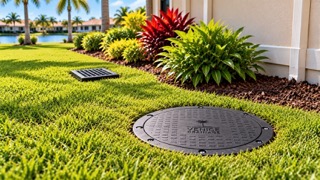
The finished sump basin remains accessible through a lid at grade so the pump can be inspected or serviced when necessary.
French drains and sump pumps can work extremely well together.
A French drain collects water from saturated soil.
The sump pump provides a way to move that collected water when gravity cannot.
For example, a French drain may run through a wet backyard and deliver water into a sump basin at the property’s lowest point.
Once the basin fills, the pump moves the water through the discharge line.
This combination can be useful for properties where installing a French drain alone would simply create a collection system with nowhere for the water to go.
Catch basins collect surface water from low areas of a yard.
Several catch basins can sometimes be connected through underground drainage pipe and routed into one sump basin.
This allows the system to collect water from multiple problem areas before pumping it away.
This type of setup can be useful for:
Roof runoff can contribute a tremendous amount of water to a drainage problem.
If downspouts terminate in a low backyard or side yard, they may add hundreds of gallons of water during a storm.
Underground downspout drainage can capture that water directly and transport it toward the appropriate drainage system.
If gravity cannot carry the water to an outlet, the downspout drainage can be incorporated into a properly designed pumped system.
Because roof runoff can enter the system quickly, pump and pipe capacity need to be considered carefully.
Channel drains collect water moving across hardscape areas such as driveways, patios, lanais, and pool decks.
Normally, the collected water exits through underground pipe using gravity.
But if the hardscape sits lower than the available outlet, gravity may not be enough.
In these situations, a deco or channel drain can collect the surface water while a sump system provides the force needed to move it away.
Whenever possible, gravity drainage has an obvious advantage: it doesn’t require a mechanical pump to move water.
If the property provides enough natural fall, gravity may be the preferred solution.
However, forcing a gravity system onto a property without enough elevation can create poor drainage performance.
A pumped system becomes valuable when:
The correct approach depends on the elevations of the specific property.
Pump sizing should be based on the drainage system rather than simply choosing the largest pump available.
Important factors include:
A pump must be capable of moving water out of the basin quickly enough to keep up with incoming stormwater.
At the same time, the rest of the system—including the discharge piping and outlet—needs to be able to handle that flow.
Landscape sump pumps rely on electricity.
If power is lost during a storm, a standard electric pump cannot operate until power is restored.
That is an important consideration when determining whether a pumped drainage system is appropriate for a property.
Depending on the application, backup options may be considered where additional protection is desired.
The drainage system should also be designed so the property isn’t unnecessarily dependent on pumping when gravity drainage is available.
Yes. Like any mechanical drainage component, a sump pump should remain accessible for inspection and maintenance.
Maintenance may include checking:
The basin lid allows access to the pump without excavating the yard again.
Pump life varies based on the pump itself, installation, operating frequency, water conditions, electrical conditions, and maintenance.
A pump that runs occasionally will experience different wear than one operating repeatedly during every heavy storm.
Because the pump is a replaceable mechanical component, the basin should remain accessible even after the surrounding yard has been restored.
It can be an important part of the solution when the flooding occurs because water cannot escape naturally.
However, simply placing a pump in a wet yard isn’t the same as designing a drainage system.
The water first needs to be collected efficiently.
That may require:
The sump system then receives that collected water and moves it away.
The best drainage systems address both collection and discharge.
Narrow side yards can be particularly difficult to drain.
They often contain:
They may also receive runoff from both neighboring homes.
If the side yard is lower than the front or back of the property, there may be no practical gravity route.
A sump basin can provide a collection point for French drains, catch basins, and downspout drainage before pumping the water toward an appropriate outlet.
The appropriate discharge location depends on the individual property and applicable drainage requirements.
That’s one of the most important parts of designing the system.
The goal is not to pump water from one problem area into another.
A drainage plan should consider:
The appropriate solution can only be determined after evaluating the site.
The cost of a landscape sump pump system depends heavily on the overall drainage design.
A general residential drainage project involving a sump pump may often begin around several thousand dollars, while larger systems involving multiple collection points, extensive piping, excavation, and pumping equipment can cost significantly more.
Important pricing factors include:
For planning purposes, a complete residential drainage project involving pumping may commonly fall within approximately $3,500 to $7,500+, although simple projects may cost less and complex systems can exceed that range.
The actual cost should be based on the drainage requirements of the property rather than a generic pump price.
A sump pump shouldn’t be treated as a shortcut for understanding a drainage problem.
We evaluate how water moves through the entire property first.
That includes determining:
Venice Drainage provides complete solutions including:
Instead of installing one component and hoping it solves the problem, we can design the drainage system around how water actually behaves on the property.
Venice Drainage provides outdoor sump pump and yard drainage solutions throughout Southwest Florida, including:
If you’re located nearby but don’t see your community listed, contact us to see whether your property is within our service area.
A landscape sump pump is an outdoor drainage pump installed inside an underground basin. Drainage water enters the basin, and the pump automatically moves that water through a discharge line when the basin reaches a predetermined level.
Yes. Outdoor sump pump systems can be specifically designed for landscape and stormwater drainage applications.
You may need a pump if water collects in an area that cannot drain effectively by gravity. An on-site evaluation can determine whether gravity drainage is possible before adding a mechanical pumping system.
Yes. A French drain can collect subsurface water and direct it into a sump basin. The pump then moves the collected water to the appropriate discharge location.
Yes. One or multiple catch basins can potentially feed an outdoor sump system depending on the drainage design and required capacity.
Roof runoff can be incorporated into certain pumped drainage systems. Because downspouts can deliver large amounts of water quickly, system capacity and pump sizing are especially important.
No. A properly configured automatic system generally activates when water inside the basin reaches the float switch’s activation level and turns off after the water level drops.
The pump and basin are installed underground. A flush or near-flush access lid remains visible so the pump can be inspected and serviced when necessary.
If the pump fails or loses power, the system cannot mechanically discharge water until operation is restored. Keeping the basin accessible allows the pump and controls to be inspected and replaced when needed.
When adequate elevation exists, gravity drainage can often move water without mechanical equipment. However, a sump pump can provide an effective solution when the property does not have enough natural fall for gravity drainage.
If your yard repeatedly floods and there simply isn’t enough elevation to move the water away naturally, installing more drainage pipe alone may not solve the problem.
Venice Drainage can evaluate the property’s elevations, determine how water should be collected, identify whether gravity drainage is possible, and design a pumped system when necessary.
Your solution may combine a landscape sump pump with French drains, catch basins, underground downspout drainage, or channel drains to create one complete drainage system.
Contact Venice Drainage today to schedule an on-site landscape sump pump and yard drainage estimate in Venice, Sarasota, or surrounding Southwest Florida communities.