
 Drainage
French Drain vs. Catch Basin: Which Is Better for Florida Yards?
If you’re trying to solve standing water or a flooded yard, you may be comparing a French drain vs. catch basin. Both are legitimate drainage components, but they collect water in very different ways.
There’s also an important distinction for Florida homeowners: the drainage system you call a “French drain” may not actually be the type of system your property needs.
Many homeowners use the term “French drain” to describe almost any underground yard drainage system. In reality, a true French drain has a specific purpose. For many Florida properties with concentrated surface water, low areas and limited elevation, a catch basin connected to gravity or expulsion drainage may be a more appropriate approach.

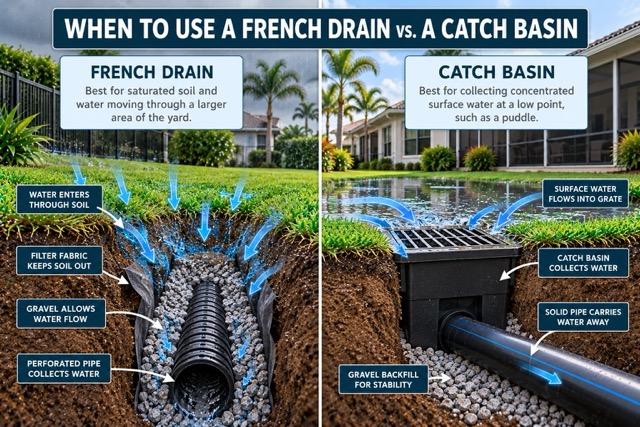
Quick answer: A catch basin collects concentrated surface water at a low point. A French drain collects water through a larger area of saturated soil. Neither system solves the complete drainage problem unless the collected water has somewhere appropriate to go.
What Is a French Drain?
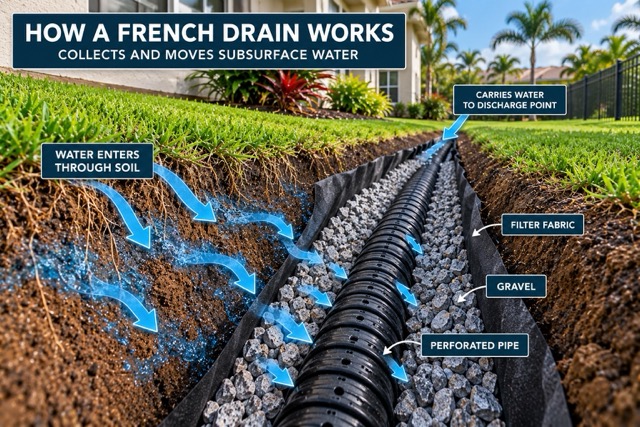
A true French drain is an underground drainage system designed primarily to collect water moving through saturated soil.
A typical French drain consists of:
- A trench
- Filter fabric
- Drainage aggregate or gravel
- Perforated drainage pipe
Water enters through the surrounding soil, moves through the aggregate and reaches the perforated pipe. The pipe then carries the collected water toward a discharge location.
Are French Drains Good for Florida Yards?
French drains absolutely have applications, but they should not automatically be treated as the answer to every Florida drainage problem.
This is where homeowner terminology and actual drainage design often separate.
Someone may call Venice Drainage and say:
“I need a French drain because my backyard floods.”
What they’re really telling us is that they have a water problem. The next step is determining what kind of water problem it actually is.
If the issue is a large area of saturated soil, a French drain may be appropriate.
But if surface water is flowing into a defined low point, installing a long perforated French drain may not be the simplest or most effective way to address the problem.
That’s why we prefer to evaluate the property before deciding which drainage system should be installed.
What Is a Catch Basin?
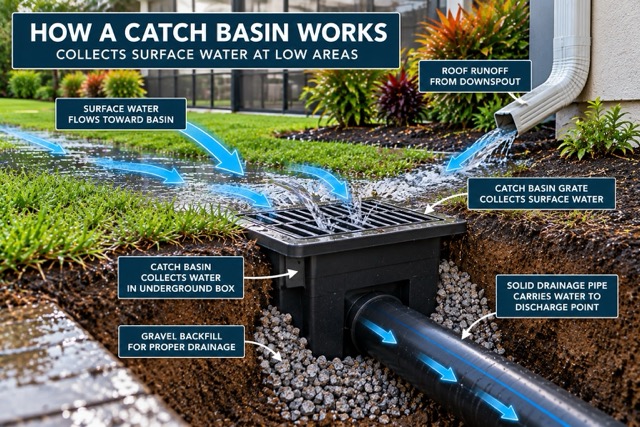
A catch basin is designed to collect surface water.
It is generally installed at or near a low area where stormwater naturally collects. The top grate allows surface water to enter the basin, and underground drainage pipe carries that water away.
This makes catch basins particularly useful when you can clearly identify where runoff is accumulating.
Why Catch Basins Are Useful for Florida Yard Drainage
Many of the drainage problems we see involve water that is already moving across the surface of the property.
That water may be coming from:
- Heavy rainfall
- Roof runoff
- Downspouts
- Pool decks
- Super gutters
- Paver driveways
- Patios and walkways
- Neighboring properties
- Higher portions of the same yard
All of that water can eventually converge at a low point.
If the problem is concentrated surface water, a catch basin can provide a direct collection point.
But once again, collecting the water is only the beginning.
The More Important Question: Where Will the Water Go?
Whether you’re using a French drain, catch basin, channel drain or another collection method, the water still needs somewhere to go.
This is one of the most important principles in drainage design.
Installing a drain where water collects does not automatically solve the problem. The system must also have a practical way to move that collected water out of the low area.
Collection and evacuation are two different parts of the drainage system.
French Drain vs. Catch Basin: What’s the Difference?
| Drainage Factor | French Drain | Catch Basin |
|---|---|---|
| Primary purpose | Collect subsurface water | Collect surface water |
| Water enters | Throughout gravel and perforated pipe | Through a surface grate |
| Best suited for | Saturated soil and distributed subsurface moisture | Defined low areas and concentrated runoff |
| Typical pipe | Perforated drainage pipe in the collection zone | Solid pipe used to transport collected water |
| Collection area | Along the length of the trench | Primarily at the basin location |
| Common homeowner terminology | Often used as a general term for underground drainage | More specifically recognized as a surface collection drain |
| Still needs a discharge plan? | Yes | Yes |
Do I Need a French Drain or Catch Basin?
The answer depends primarily on how the water reaches the problem area.
A French Drain May Make Sense When:
- The soil remains persistently saturated
- Water is moving through a broader area of soil
- Subsurface moisture is a significant part of the problem
- There is an appropriate location to move the collected water
A Catch Basin May Make Sense When:
- Water visibly collects at a low point
- Surface runoff moves toward one area
- Roof or downspout water reaches the area
- Hardscape runoff contributes to the problem
- The collected water can be piped to another location
What We Often Install Instead of a Traditional French Drain
For many Florida properties, the drainage problem is less about trying to dry an entire area of soil and more about getting water out of a low area and moving it somewhere appropriate.
That is why Venice Drainage frequently approaches these projects using gravity drainage or expulsion drainage.
The system may include:
- Catch basins at strategic low points
- Solid underground drainage pipe
- Underground downspout connections
- Channel or deco drains where hardscape runoff needs to be intercepted
- Gravity drainage where sufficient elevation is available
- Landscape sump pumps where water must be actively moved
Our goal isn’t simply to put a drain where the water is. It’s to get the water out of the low area and move it to the right discharge location.
Gravity Drainage: Moving Water Naturally
If there is enough elevation difference between the flooded area and an appropriate discharge location, gravity can often move the water.
The basic concept is simple:
Water Collects
Collects Water
Moves Water
Discharge
This is the principle behind many of our yard and gravity drainage systems .
The important part is confirming that adequate positive fall actually exists.
When appropriate, we use laser leveling technology to evaluate property elevations rather than simply assuming a direction is downhill.
What If Gravity Can’t Move the Water?
Florida properties are often relatively flat. Sometimes we can identify exactly where water needs to be collected but there isn’t enough natural elevation to move it to the desired discharge point.
That’s where an expulsion drainage system may be considered.
Instead of relying entirely on gravity, water is collected from the low area and mechanically moved through the drainage system toward the designed discharge location.
Depending on the property, this may involve a landscape sump pump system.
Standing Water
Collects Water
Expels Water
Designed Location
Why Not Just Install a French Drain Everywhere?
Because different drainage problems require different collection methods.
Imagine a backyard where several inches of surface water collect at one obvious low point during a Florida rainstorm.
If that water is already moving across the surface toward a predictable location, it may make more sense to collect it directly rather than waiting for it to infiltrate through soil and aggregate before entering perforated pipe.
Likewise, if the primary problem is roof runoff, the better approach may be to capture the water at the downspouts before it ever reaches the flooded area.
If runoff is moving across a pool deck or paver area, a channel or deco drain may be more appropriate.
The drainage component should match the way the water is actually moving.
Can a French Drain and Catch Basin Be Used Together?
Yes.
Some properties have more than one drainage condition.
For example, a property could have saturated soil along a side yard while also experiencing concentrated surface water in a backyard low point.
A properly designed system could use different collection methods while ultimately moving the water toward a common drainage route or appropriate discharge location.
The important point is that each component should have a purpose.
Drainage Capacity Still Matters
Choosing between a French drain and catch basin is only one part of the design.
The system also needs to handle the amount of water reaching it.
A low area may receive water from the lawn, roof, multiple downspouts, pool deck, super gutter, driveway and neighboring properties at the same time.
That means the drainage system should be evaluated as a whole.
Pipe diameter, elevation, slope, pipe characteristics, collection points, runoff sources and discharge conditions can all affect system performance.
Collecting Water Is Only Half the Job
A drainage system has to collect the problem water and move it away efficiently.
That is why Venice Drainage starts with the property and the water problem instead of automatically prescribing a particular type of drain.
Not Sure Which Type of Drain You Need?
You don’t need to diagnose the drainage system yourself.
If you’re searching for a French drain because your yard floods, that’s enough information to start the conversation.
During a drainage assessment, the questions we want to answer include:
- Where is the water coming from?
- Where does it collect?
- Is the problem primarily surface water or subsurface water?
- What are the property elevations?
- Where can the water appropriately be moved?
- Can gravity move it?
- If not, does it need to be mechanically expelled?
- How much water does the system need to handle?
Once those questions are answered, we can determine whether the property needs a French drain, catch basin, gravity drainage, downspout drainage, channel drain, expulsion system or a combination.
Dealing With Standing Water or Yard Flooding?
If you’re still trying to understand the source of your drainage problem, these guides may help:
- Why Is Water Pooling in My Yard After Heavy Rain?
- How to Fix Standing Water in Your Yard in Florida
- Best Drainage Solutions for Florida Yards
- How Much Does a French Drain Cost in Florida?
French Drain vs. Catch Basin FAQs
Is a catch basin better than a French drain?
Neither is universally better. A catch basin is generally designed to collect concentrated surface water at a low point, while a French drain collects water through a larger area of saturated soil. The better option depends on the source and movement of the water.
Do I need a French drain for standing water in my yard?
Not necessarily. If surface water is visibly flowing toward a defined low point, a catch basin connected to an appropriate drainage system may make more sense. French drains are generally better suited to certain subsurface water and saturated-soil conditions.
What’s the difference between a French drain and a yard drain?
A traditional French drain uses perforated pipe and aggregate to collect water through the surrounding soil. The term “yard drain” often refers to a surface collection system using a grate or catch basin connected to underground pipe.
Can a catch basin drain by gravity?
Yes. If there is an appropriate lower discharge location and enough positive fall along the pipe route, water collected by a catch basin can be transported using gravity.
What if my yard is too flat for gravity drainage?
If sufficient elevation isn’t available, the collected water may need to be mechanically moved using an expulsion drainage system, such as a properly designed landscape sump pump system.
Can a French drain and catch basin connect to the same drainage system?
Potentially. Properties can have multiple sources and types of water. Different collection methods can sometimes be incorporated into a larger drainage design when site conditions support it.
Why do people call every yard drain a French drain?
“French drain” has become a commonly recognized homeowner term for underground yard drainage. Technically, however, a French drain refers to a particular type of subsurface drainage system using aggregate and perforated pipe.
How do I know which drainage system my Florida yard needs?
Start by identifying where the water originates, where it collects, the property elevations and where the water can appropriately be discharged. A drainage assessment can then determine which collection and evacuation methods fit the property.
Think You Need a French Drain?
You might — but you may actually need a completely different drainage system.
You don’t need to know the technical name before contacting us. Tell Venice Drainage where the water is collecting and what happens when it rains. We’ll evaluate how the water is reaching the area, the property elevations and where that water can appropriately be moved.
From there, we can determine whether the property calls for a French drain, catch basin, gravity drainage, expulsion drainage or another solution.
