- 509 Cypress Ave, Venice FL 34285
- Mon to Friday: 8:00 am - 6:00 pm
If you have standing water, a flooded backyard, a soggy side yard or stormwater collecting around your home, you don’t need to know what type of drainage system you need before calling us.
That’s what the drainage assessment is for.
Venice Drainage provides residential and commercial drainage assessments in Venice, FL and surrounding Southwest Florida communities to determine why water is collecting and what can be done to move it.
Instead of arriving with a predetermined solution, we evaluate how water actually moves across your property.
Our process comes down to four basic questions:
Where is the water coming from?
Where is it collecting?
Why isn’t it draining?
Where can we move it?
Once we understand those four things, we can determine the simplest practical drainage solution for the property.

One of the most common things we hear from homeowners is:
“I know I have a drainage problem, but I don’t know what I need.”
That’s completely fine.
You don’t need to decide whether you need a French drain, catch basin, channel drain, sump pump or another type of drainage system before scheduling an assessment.
In fact, choosing the drainage product before understanding the water problem can lead to an unnecessarily complicated system — or one that doesn’t address the actual cause.
Show us where the water is causing a problem.
Our job is to figure out why it’s happening and how to move the water.
A drainage assessment is an on-site evaluation of the property and the areas experiencing flooding, standing water or poor drainage.
We walk the property, discuss what happens during heavy rain and evaluate the conditions that influence how stormwater moves.
Depending on the property, we may look at:
The goal is not simply to find the puddle. We want to understand why the water is there in the first place.
Water collecting in one area does not necessarily originate there.
Stormwater may travel across several parts of the property before reaching the area where you finally see it standing.
Common sources include:
Understanding the source helps us determine whether we need to collect the water at the flooded area or intercept it before it gets there.
Next, we identify the low areas where stormwater naturally accumulates.
These locations often become the potential collection points for a drainage system.
Depending on the situation, water may collect:
We also consider whether the problem is primarily surface water or whether the soil itself remains saturated.
That distinction can influence whether a catch basin, French drain or another drainage method makes the most sense.
Once we know where the water originates and where it collects, the next question is why it remains there.
There are several possible reasons.
The property may simply be too flat.
There may be a low area with no outlet.
A large amount of roof runoff may be concentrated into a small section of the yard.
A driveway or patio may have changed how stormwater moves.
The surrounding soil may remain saturated after heavy rain.
An existing drainage system may not collect water from the right location.
Or there may be a usable discharge point, but no drainage route connecting the flooded area to it.
Finding the cause is what allows us to recommend the right solution.
Elevation is one of the most important parts of drainage.
Water moves downhill.
Before recommending a gravity drainage system, we need to determine whether the property actually has enough fall to move water from the collection area to the potential discharge point.
When needed, we can use elevation measurements to compare different areas of the property.

This is one of the most important questions we answer during the assessment.
If the flooded area is higher than an appropriate discharge point, we may be able to move the water naturally through underground drainage pipe.
The system can sometimes be very simple:
Point A → Underground Pipe → Point B
Or, when surface water needs to be collected:
Low Area → Catch Basin → Underground Pipe → Discharge Point
When the property elevations allow it, gravity drainage can provide a straightforward solution without mechanical pumping.
Learn more about our yard drainage and gravity drainage systems.
Collecting the water is only half of a drainage system.
The water needs somewhere to go.
During the drainage assessment, we evaluate potential discharge locations and how the water could reach them.
The appropriate discharge point depends on the property, elevations, existing drainage infrastructure, surrounding conditions and applicable requirements.
We don’t want to simply move a drainage problem from one area of the property to another.
The collection point, drainage route and discharge location need to work together as one system.
Once we understand the problem and the available discharge route, we can determine the appropriate collection method.
Different drainage problems require different solutions.
Catch basins are commonly used when surface water concentrates in a specific low area.
The basin collects the water and directs it into underground drainage pipe.
A French drain may be appropriate when water is trapped within saturated soil rather than simply pooling on the surface.
French drains use perforated drainage pipe and stone to collect subsurface water.
Channel and deco drains can intercept water moving across wider hardscape surfaces such as paver driveways, patios, pool decks and entrances.
If concentrated roof runoff is contributing to the problem, underground downspout drainage may be used to move that water away from the immediate area around the home.
Some properties have more than one drainage issue.
For example, a system might combine catch basins for surface water with underground downspout drainage for roof runoff.
The important thing is that every component has a reason for being there.
Not every flooded yard needs a sump pump.
If gravity can move the water effectively, we generally prefer to keep the system simple.
However, Southwest Florida has many relatively flat properties where the flooded area may be lower than the available discharge location.
If there is not enough natural fall, a landscape sump pump may be considered.
In a pumped drainage system, water is collected into an underground basin and mechanically moved through a discharge line.
The assessment helps us determine whether pumping is actually necessary rather than automatically adding a pump to the system.
Once we understand the water source, collection area, elevations and discharge options, we can develop the proposed drainage solution.
The basic concept is:
Collect the water → move the water → discharge the water.
That may involve one simple drainage line or several components working together.
The system should be based on the actual conditions of the property — not on installing as many drains as possible.
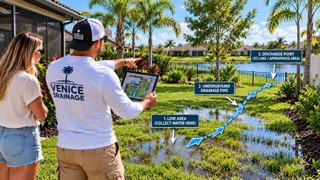
Flooding mitigation starts with understanding how stormwater moves across the entire property.
We don’t want to look at one puddle without considering what is feeding it.
A backyard may be flooding because water is coming from the roof.
A side yard may stay wet because it is the lowest point between two homes.
A paver driveway may be directing runoff toward a landscape area.
A pool deck may be adding additional runoff to an already low section of the yard.
By looking at the overall movement of water, we can determine whether it makes more sense to collect the water at the flooded area, intercept it earlier, or do both.
Drainage does not need to be complicated just for the sake of being complicated.
If one properly located catch basin and an underground gravity line can solve the problem, there may be no reason to install an elaborate drainage network.
Likewise, if the problem is saturated soil rather than concentrated surface water, installing catch basins everywhere may not address the actual issue.
The drainage system should match the drainage problem.
Backyard flooding is one of the most common reasons homeowners request a drainage assessment.
We look at:
A flooded backyard does not automatically mean a French drain is needed. Depending on the property, a catch basin and gravity line may make more sense, while another property may require a pump or subsurface drainage.
Side yards can be especially challenging because they are often narrow and relatively flat.
They may also receive water from multiple roof downspouts and runoff from neighboring elevations.
During the assessment, we determine whether the side yard has enough fall toward the front or back of the property and whether an underground drainage route is practical.
This is often where accurate elevation measurements become particularly useful.
Paver driveways and other hardscapes change how stormwater moves across the property.
During an assessment, we look at where water leaves the paver surface and what happens once it reaches the edge.
Uncontrolled runoff can contribute to:
Depending on the problem, the solution might involve a catch basin, channel drain, underground drainage route or changes to how runoff is collected.
Roof runoff can create a surprisingly large drainage problem because gutters concentrate water from a large roof area into a small number of downspouts.
We evaluate where those downspouts terminate and whether they are contributing to the flooded area.
In some situations, correcting the roof runoff is an important part of solving the larger yard drainage problem.
If your property already has drainage, we can also evaluate how the existing system relates to the current problem.
We may look at:
Sometimes an existing drainage system can be supplemented rather than completely replaced.
A drainage assessment can also be performed before a new property is completely finished.
This is often an ideal time to identify drainage routes because underground piping can be installed before sod, landscaping and hardscapes make access more difficult.
If you are building a home or completing a new property, learn more about our new construction drainage and stormwater mitigation services.
The same basic process applies to commercial properties.
We identify where runoff originates, where it collects, how the site is graded and what drainage options are available.
Commercial assessments may involve:
Learn more about our commercial drainage solutions.
After evaluating the property, we can recommend a drainage approach based on what we found.
The proposed solution may identify:
From there, we can provide a detailed estimate for the recommended drainage work.
Depending on the assessment, Venice Drainage may recommend one or a combination of the following:
Our goal is to understand the property before recommending the solution.
We look beyond the standing water itself and evaluate the source of the runoff, the low areas, the elevations, the available drainage routes and the potential discharge locations.
Then we determine which drainage method makes sense.
We aren’t trying to make the system complicated. We’re trying to make the property drain.
Venice Drainage provides drainage assessments and flooding mitigation solutions throughout Venice and surrounding Southwest Florida communities, including:
No. You only need to show us the drainage problem. The purpose of the assessment is to determine why the water is collecting and what type of drainage system makes sense for the property.
We evaluate the problem areas, possible water sources, property elevations, roof runoff, hardscapes, existing drainage and potential discharge locations. When appropriate, elevation measurements can help determine whether gravity drainage is practical.
We evaluate the property’s elevations, available drainage routes, surrounding conditions and potential discharge locations. The goal is to identify an appropriate route that moves collected water away from the problem area without simply creating another drainage problem elsewhere.
When elevation differences are important to the proposed drainage solution, measurements can be used to determine whether there is enough natural fall between the collection area and potential discharge point.
Not necessarily. French drains are useful for certain subsurface drainage problems, but concentrated surface water may be better addressed with catch basins and underground piping. The assessment helps determine which approach fits the problem.
Not necessarily. If the property has sufficient natural fall to an appropriate discharge point, gravity drainage may be possible. A sump pump is generally considered when gravity cannot move the water effectively.
Visible standing water can provide useful information about where water is collecting. However, drainage conditions can also be evaluated when the yard is dry by looking at elevations, runoff sources, low areas and other site conditions.
Yes. If your property already has drains, we can evaluate how the existing system relates to the current drainage problem and whether additional drainage may be appropriate.
Yes. Evaluating drainage before new pavers, sod or landscaping are installed can be beneficial because drainage routes and elevations can be considered before the property is finished.
Once we understand the drainage problem, we can recommend an appropriate mitigation approach and provide a detailed estimate for the proposed work.
If your yard floods, water collects between homes, your side yard stays wet or stormwater is creating problems around your driveway, landscaping or outdoor areas, you don’t need to diagnose the problem yourself.
Show us where the water is causing a problem. We’ll evaluate where it comes from, why it collects and how it can be moved.
Our process is simple:
Find the source → identify the low area → check the elevations → establish a drainage route → determine the appropriate solution.
Contact Venice Drainage today to schedule a drainage assessment in Venice, Wellen Park, Nokomis, Sarasota, Englewood, North Port or surrounding Southwest Florida communities.