- 509 Cypress Ave, Venice FL 34285
- Mon to Friday: 8:00 am - 6:00 pm
Good drainage should be planned before the pavers, sod, landscaping, pool deck and other finished surfaces go in — not after standing water and erosion become a problem.
Venice Drainage provides new construction drainage and stormwater mitigation in Venice, FL for homeowners, builders, paver contractors, pool contractors, landscapers and other construction professionals.
We install drainage systems designed to collect and redirect stormwater before it can create standing water, erode landscaping, wash out paver base or cause problems around a newly constructed home.
When drainage is installed during construction, we can work with the property’s elevations while the site is still accessible and install underground drainage before the finished landscaping and hardscapes make the project more difficult.
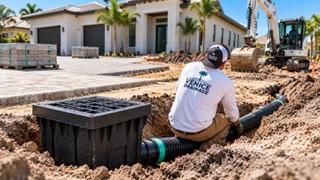
One of the best times to install a drainage system is while the property is still under construction.
At this stage, trenches can be excavated before sod is installed, drainage pipe can be routed before landscaping is finished, and collection points can be coordinated with paver driveways, walkways, patios and pool decks.
This gives us the opportunity to think about the entire path of the water:
Where is the water coming from?
Where will it collect?
Where can it safely be moved?
Answering those questions before the property is finished can prevent expensive drainage corrections later.
A newly constructed property can dramatically change how stormwater moves across a lot.
Before construction, rainfall may have been distributed across open soil. Once the home and hardscapes are installed, large areas become covered by surfaces that do not absorb water the same way.
These can include:
Instead of soaking into the ground where it falls, stormwater is concentrated and redirected into other areas of the property.
That makes proper drainage especially important on new construction properties in Southwest Florida.
A beautiful new paver driveway can still develop problems if stormwater is allowed to flow underneath or alongside the paver system.
The pavers themselves may not be the problem. The uncontrolled water around them can be.
Water moving along the edge of a driveway or beneath the paver system can gradually carry away sand, soil or supporting material.
Over time, this can contribute to:
Planning drainage before the pavers are completed gives us an opportunity to intercept stormwater before it becomes a problem.
Paver driveways create a large surface that can receive significant rainfall during a Florida storm.
How the driveway is graded determines where much of that water will travel.
If runoff is directed toward the wrong area, it may collect near the garage, wash across landscaping, flow toward neighboring property, or erode material along the driveway edge.
Depending on the site, driveway drainage can include:
The drainage should work with the finished elevation of the driveway rather than being treated as an afterthought.
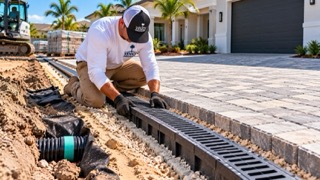
Channel drains are particularly useful when water needs to be intercepted across a wide paved area.
A properly positioned channel drain can collect surface runoff before it crosses an entrance, reaches a garage, or flows into an area where it could contribute to erosion.
The collected water is then connected to underground drainage piping and directed toward an appropriate discharge location.
Learn more about our deco and channel drain installation.
Catch basins provide a simple way to collect stormwater from low areas.
During new construction, we can identify locations where water will naturally concentrate once the final elevations are established.
A typical system may be as simple as:
Low Area → Catch Basin → Underground Pipe → Discharge Point
If the property has sufficient elevation change, the water can often move naturally through the underground pipe using gravity.
This is one reason drainage planning during construction is valuable. We can establish the collection point and pipe route before sod, landscape beds and other finished surfaces are installed.
Whenever practical, gravity is one of the simplest ways to move stormwater.
If there is sufficient fall between the problem area and the available discharge location, underground drainage pipe can move collected water without a pump.
The concept is straightforward:
Point A → Underground Drainage → Point B
We evaluate the elevations of the property and determine whether gravity drainage is practical before adding unnecessary complexity.
Learn more about our yard drainage and gravity drainage systems.
A new roof creates one of the largest concentrated sources of stormwater on the property.
During a heavy Florida rain, gutters collect water from the roof and send that runoff to a relatively small number of downspouts.
If those downspouts simply discharge beside the house, large amounts of water can be concentrated into landscape beds, along the foundation, beside walkways, or near paver areas.
Underground downspout drainage can carry roof runoff away from the home and direct it toward an appropriate discharge location.
Installing these lines before the landscaping is completed can make the finished system much cleaner.
Pool decks, patios and outdoor living areas also change how water moves across a new property.
These hard surfaces need to direct rainfall somewhere.
Depending on the layout, drainage may include:
Planning these systems before the final hardscape is installed allows the drain locations and elevations to work together.
Side yards are one of the most common areas where new homes can experience drainage problems.
There may be limited space between homes, roof runoff may be concentrated in the area, and the elevation difference between the front and back of the property may be minimal.
Once fences, air-conditioning equipment, landscaping and sod are installed, correcting the drainage can become more difficult.
Installing catch basins and underground drainage while the side yard is still accessible can provide a much cleaner solution.
Catch basins are designed primarily to collect concentrated surface water. Some properties also need help managing water that remains trapped within saturated soil.
In those situations, a French drain may be appropriate.
A French drain uses perforated pipe and drainage stone to collect subsurface water and move it away from wet areas.
French drains can also be combined with catch basins when a property has both surface runoff and saturated soil conditions.
Some Southwest Florida properties simply do not have enough natural elevation to move collected water to the desired discharge point.
When gravity cannot do the job, a landscape sump pump system may be considered.
The drainage system collects stormwater into an underground basin. A pump then mechanically moves the water through a discharge line.
This can be combined with catch basins, channel drains, French drains, or downspout drainage depending on the property.
We prefer to keep systems as simple as practical, so gravity drainage is evaluated before mechanical pumping is added.
Stormwater mitigation is about controlling how rainfall moves across the completed property.
A new home may receive runoff from several sources at the same time:
The drainage system should consider how those areas interact rather than treating every puddle as an isolated problem.
Depending on the property, a stormwater mitigation plan may combine several drainage methods to collect water and direct it through a controlled route.
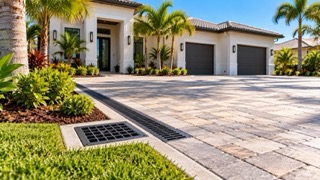
Drainage installation often requires excavation.
If underground drainage is installed before the sod and landscaping, there is less finished material that needs to be disturbed and restored.
This is especially useful when installing:
Once the drainage is installed, the final grading, irrigation, landscaping and sod can be completed around the system.
If a new paver driveway, patio or walkway is planned, coordinating drainage before the pavers are installed can prevent unnecessary removal later.
Underground piping can be routed beneath or around future hardscapes where appropriate, while channel drain locations can be coordinated with the final paver elevations.
This is particularly important around:
The structural performance of a paver installation depends heavily on what is underneath it.
If uncontrolled runoff continually carries away surrounding material or enters vulnerable areas around the base, the support beneath the pavers can be affected.
Drainage helps by giving stormwater a controlled collection and discharge route instead of allowing it to find its own path.
This is particularly important around the perimeter of large paver areas where concentrated runoff can cause erosion.
Venice Drainage can work with builders and contractors to install drainage during the appropriate phase of construction.
We can coordinate drainage work around:
Getting involved before the final surfaces are completed can simplify installation and reduce the amount of finished work that needs to be disturbed.
If a paver contractor identifies a drainage concern before installing a driveway or patio, addressing the water first can help protect the finished project.
We can evaluate where runoff will travel and install the necessary catch basins, underground piping, channel drains or other drainage components before the paver project is completed.
This allows the paver system and drainage system to work together instead of trying to retrofit drainage afterward.
Pool construction can significantly change the elevations and hardscape surfaces in a backyard.
Before the deck and landscaping are completed, we can evaluate where rainfall from the new surfaces will travel and whether additional drainage is needed.
This can include channel drains, catch basins and underground piping around the pool and surrounding landscape areas.
Final grading and landscaping have a major influence on how stormwater moves across a property.
Installing drainage before landscape completion gives contractors an opportunity to finish the property around established collection points and underground drainage routes.
It also helps avoid excavating through newly installed sod or landscape beds later.
We evaluate the home, planned hardscapes, landscape areas, roof runoff, property elevations and potential discharge locations.
We determine where runoff is likely to concentrate once construction is complete.
Catch basins, channel drains, downspout connections or other collection points are positioned where they can intercept water effectively.
We determine how collected water can move from the collection point to an appropriate discharge location.
Drainage pipe and other components are installed while access to the property is still relatively open.
Drainage grates and channel drains need to work with the final grade of the sod, landscaping and hardscape.
Once installed, the property can be completed with most of the drainage system hidden underground.
We don’t believe every new construction property needs an unnecessarily complicated drainage network.
Sometimes the best solution is simply:
Catch the water at Point A → move it underground → discharge it at Point B.
Other properties may require several collection points or different types of drainage working together.
The goal is to install the system the property actually needs.
Drainage can often be added after a home is completed, but construction-stage installation has several advantages.
Installing drainage early may allow us to:
In short: it is usually better to plan where the water will go before the first major storm shows you where it wants to go.
The cost of a new construction drainage system depends on the size and layout of the property and the type of drainage required.
Important factors include:
Because every new construction property is different, an on-site evaluation is the best way to determine the appropriate system and provide a detailed estimate.
Venice Drainage understands both drainage and hardscape construction.
That is particularly important when drainage is being installed around paver driveways, walkways, patios and other finished surfaces.
Our goal is not to make the drainage system more complicated than necessary.
We look at how water moves across the property and design a practical system to collect it and move it away.
Our new construction drainage solutions can include:
Venice Drainage provides new construction drainage and stormwater mitigation services throughout Venice and surrounding Southwest Florida communities, including:
Ideally, drainage should be evaluated before the final sod, landscaping, pavers and other hardscapes are completed. The exact installation timing depends on the construction schedule and the drainage system being installed.
Proper drainage can help control runoff that would otherwise travel along or beneath vulnerable areas of a paver installation. Intercepting and redirecting stormwater can help reduce erosion and washout around the paver base.
It depends on the driveway elevations and where runoff travels. Channel drains, catch basins, underground piping and gravity drainage are common options. Some properties may require a combination of systems.
When possible, drainage planning should occur before the pavers are installed. This allows underground piping and drain locations to be coordinated with the finished driveway elevations and can reduce the need to remove completed hardscape later.
Yes. Underground downspout drainage can move concentrated roof runoff away from the immediate area around the home when site conditions and the available discharge route allow it.
No. If the property has enough natural fall, water may be able to move through underground drainage using gravity. A pump is generally considered when the desired discharge point is higher than the collection area or gravity drainage is otherwise impractical.
Yes. Installing underground drainage before sod is often advantageous because trenches can be excavated and restored before the finished lawn is installed.
Yes. Drainage installation can be coordinated with builders, paver contractors, pool contractors and landscape contractors so the drainage components are installed during the appropriate phase of construction.
For a residential property, stormwater mitigation generally involves managing runoff by controlling where water is collected, how it moves across or beneath the property, and where it is ultimately discharged in accordance with site conditions and applicable requirements.
Yes. Existing homes can still have drainage installed. However, planning drainage during construction may reduce the amount of finished sod, landscaping or hardscape that needs to be disturbed.
If you are building a new home, installing a paver driveway, adding a pool or preparing for final landscaping, now is the time to think about where the stormwater will go.
Venice Drainage can evaluate the property and design a practical system around the finished elevations of the home, driveway, landscaping and outdoor areas.
Protect the pavers. Control the runoff. Plan the drainage before the property is finished.
Contact Venice Drainage today to schedule an on-site new construction drainage estimate in Venice, Wellen Park, Nokomis, Sarasota, Englewood, North Port or surrounding Southwest Florida communities.