- 509 Cypress Ave, Venice FL 34285
- Mon to Friday: 8:00 am - 6:00 pm
Standing water, soggy grass, and flooded side yards are common problems for homeowners throughout Venice and Southwest Florida. When water remains trapped in the soil instead of draining away, a professionally installed French drain can provide an effective way to collect that excess water and redirect it away from problem areas.
Venice Drainage provides professional French drain installation in Venice, FL and throughout Sarasota County and surrounding Southwest Florida communities. We design drainage systems around the actual conditions of your property—including elevation, roof runoff, low areas, saturated soil, existing landscaping, and where the collected water can safely go.
Whether you’re dealing with a constantly wet side yard, standing water after heavy rain, or a larger backyard drainage problem, we’ll help determine whether a French drain is the right solution for your property.

A French drain is an underground drainage system designed primarily to collect water from saturated soil.
A properly installed system typically includes:
Water moves through the surrounding stone and enters the perforated pipe. Once inside the pipe, it can be transported away from the wet area toward an appropriate discharge point.
The concept is simple. Designing the system correctly for a specific property is the important part.
French drains are particularly effective when water is saturating the soil rather than simply flowing across the surface.
A French drain may be appropriate if you are experiencing:
However, not every wet yard needs a French drain.
If the problem is primarily fast-moving surface water, a catch basin or yard drain may be more effective. If the water comes primarily from the roof, underground downspout drainage may need to be addressed first.
Properties with insufficient elevation for gravity drainage may require a landscape sump pump as part of the system.
A French drain works by creating an easier path for excess groundwater to follow.
Instead of water remaining trapped in saturated soil, it moves into the gravel-filled drainage trench and through openings in the perforated pipe.
The pipe then transports the collected water away from the problem area.
For the system to work properly, three things need to happen:
The third step is often overlooked.
Installing 50 or 100 feet of drainage pipe doesn’t solve a water problem if the pipe has nowhere to discharge.
That’s why property elevations and the intended outlet should be considered before excavation begins.
A professional French drain installation involves much more than burying corrugated pipe in the ground.
We start by identifying where water is collecting and what may be causing the problem.
We look at factors such as:
Once the problem is understood, the drainage system can be routed through the areas where it will collect water most effectively.
We also determine where that water can be transported.
The trench is excavated to the required depth and slope.
Depth varies depending on the purpose of the system, site conditions, surrounding elevations, and the intended outlet.
Drainage fabric helps separate the surrounding soil from the drainage stone.
This is important because soil and sediment can gradually migrate into the stone and reduce the system’s drainage capacity.
Perforated drainage pipe is installed within clean drainage stone so groundwater can enter the system.
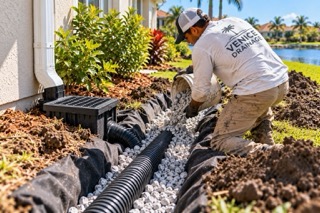
Depending on the property, the French drain may be only one part of the overall system.
Additional components may include:
After the drainage system is installed, the excavated area can be restored based on the surrounding landscape and project requirements.
Southwest Florida presents several unique drainage challenges.
Florida thunderstorms can deliver a large amount of rain in a short period of time.
Even yards that drain adequately during light rainfall can develop standing water during intense summer storms.
Venice and much of Sarasota County are relatively flat.
Small differences in elevation can determine whether water moves away from a home or becomes trapped in a lawn or side yard.
During extended wet periods, the soil may already contain significant moisture when another storm arrives.
This can dramatically slow natural infiltration and leave lawns saturated.
Side-yard drainage problems are especially common.
These areas often receive roof runoff from neighboring homes while containing fences, air-conditioning equipment, utility lines, irrigation systems, and landscape beds.
When the area is also relatively flat, water can have nowhere to go.
A wet side yard is one of the most common reasons homeowners consider French drain installation.
Water may collect between homes because of:
A side-yard drainage system may use a French drain to collect subsurface water while catch basins collect surface water.
Downspouts may also be routed into separate solid drainage pipe to keep concentrated roof runoff from entering the lawn.
French drains and catch basins solve different types of drainage problems.
French drains collect water from saturated soil.
Catch basins collect water directly from the surface.
If a large puddle forms quickly during a thunderstorm, a surface drain may help collect that water faster.
If the lawn remains wet and soggy for days afterward, subsurface drainage may also be necessary.
Many Florida properties benefit from using both systems together.
Roof runoff should always be considered when diagnosing yard drainage.
Gutters collect rain from a large roof area and concentrate it into several downspouts. If those downspouts terminate beside the home, they can contribute a significant amount of water to the surrounding soil.
Downspout drainage systems typically use solid pipe to transport roof water.
French drains typically use perforated pipe to collect water from surrounding soil.
A property experiencing both problems may require both systems.
A French drain is generally installed within soil or landscaped areas.
A deco drain or channel drain is typically used to intercept surface water moving across hardscapes such as:
If water is flowing across a paver driveway, installing a French drain in the lawn may not address the actual problem.
The drainage system should match the source and movement of the water.
A French drain collects water. A sump pump moves water mechanically.
In many situations, gravity can move water from a French drain toward an appropriate outlet.
But some Florida properties are too flat for gravity drainage to work effectively.
In these situations, the French drain and other yard drains may feed into a basin containing a landscape sump pump.
When water reaches a certain level, the pump activates and moves the water through a discharge line.
Some of the most effective drainage systems combine several methods.
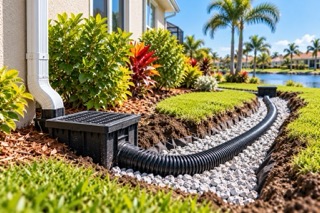
For example, a property might use:
The goal is not to install as much drainage as possible.
The goal is to install the right drainage components in the right locations.
French drain pricing depends on the size and complexity of the project.
As a general planning range, professionally installed French drains may cost approximately $25 to $50+ per linear foot.
Many residential drainage projects may fall between approximately $2,500 and $5,000+, while larger or more complicated systems can cost $5,000 to $10,000+.
Systems involving pumps, extensive excavation, multiple drainage components, difficult access, or significant restoration can exceed those ranges.
Factors affecting cost include:
For a more detailed breakdown, see our guide to French drain costs in Sarasota, FL and our Florida French drain cost guide.
A properly designed and installed French drain can provide effective drainage for many years.
One of the biggest factors affecting longevity is keeping sediment out of the drainage stone and pipe.
Quality filter fabric helps prevent surrounding soil from migrating into the system and gradually reducing its ability to collect water.
Proper materials and installation are important if you want the drainage system to continue working long after the trench has been covered.
A basic French drain can be installed as a DIY project, but drainage problems can become complicated quickly.
Common installation mistakes include:
The most important question is not simply, “Where should we put the French drain?”
It’s:
“Where is the water coming from, and where are we going to send it?”
Consider having your property evaluated if you regularly notice:
The presence of these symptoms doesn’t automatically mean a French drain is the answer, but it does indicate that the property’s drainage should be evaluated.
Drainage problems aren’t solved by simply burying pipe.
A successful system requires understanding how water moves across the property and selecting the right combination of drainage methods.
Venice Drainage provides solutions for:
We evaluate the property first and then recommend a drainage system based on the actual problem.
Venice Drainage provides French drain installation and yard drainage solutions throughout Southwest Florida, including:
If you are outside these areas but located nearby, contact us to see whether your property is within our service area.
If you’re tired of standing water, soggy grass, or a side yard that becomes unusable every time it rains, Venice Drainage can evaluate the property and determine what is causing the problem.
We’ll look at how water enters the area, how it moves across the property, and where it can safely be redirected.
The right solution may be a French drain—or a combination of French drains, catch basins, downspout drainage, channel drains, and pumping systems.
Contact Venice Drainage today to schedule an on-site French drain and yard drainage estimate.
Yes. French drains can be highly effective for saturated soil and subsurface water problems in Florida when the system is properly designed and has an appropriate discharge location.
A general planning range is approximately $25 to $50+ per linear foot, although actual pricing depends on depth, access, materials, system design, drainage length, discharge requirements, and other site conditions.
There is no single correct depth for every property. The appropriate depth depends on what water the system needs to collect, surrounding elevations, pipe slope, the intended outlet, and other site conditions.
A French drain can help when standing water is related to saturated soil or subsurface drainage. Large amounts of surface runoff may require catch basins, grading, or other drainage components as well.
Yes. French drains and catch basins can be incorporated into the same overall drainage system when a property experiences both saturated soil and surface water.
Yes. Downspouts can be connected to underground solid drainage pipe to transport roof runoff away from problem areas. The design should account for the volume and destination of the collected water.
Not necessarily. If the property has enough elevation for gravity drainage, a pump may not be needed. A landscape sump pump can be useful when collected water must be moved uphill or the property doesn’t provide sufficient natural fall.
A French drain generally collects water from saturated soil through gravel and perforated pipe. A yard drain or catch basin collects water directly from the surface through a grate.
Installation time depends on the length and complexity of the project, excavation conditions, access, weather, additional drainage components, and restoration requirements. Many residential drainage projects can be completed relatively quickly once the system has been properly designed.
The best solution depends on the source of the water. French drains, catch basins, downspout drainage, channel drains, grading, and landscape sump pumps each solve different drainage problems. Many properties benefit from a combination system.
A wet yard isn’t just inconvenient. Recurring standing water can make lawns and side yards difficult to use, damage landscaping, create muddy conditions, and indicate that stormwater isn’t moving through the property effectively.
A properly designed drainage system addresses the cause instead of repeatedly treating the symptoms.
Venice Drainage provides professional French drain installation in Venice, Sarasota, and surrounding Southwest Florida communities.
Schedule an on-site estimate and let us determine the best way to collect, move, and manage excess water on your property.