- 509 Cypress Ave, Venice FL 34285
- Mon to Friday: 8:00 am - 6:00 pm
Standing water isn’t just an inconvenience on a commercial property. It can interfere with parking, pedestrian areas, landscaping, building access, and the overall appearance and usability of the property.
Venice Drainage provides commercial drainage solutions in Venice, FL and throughout Sarasota County and surrounding Southwest Florida communities.
We install drainage systems for businesses, commercial properties, HOAs and condominium communities, retail centers, offices, apartment communities, churches, schools, warehouses, and other properties.
Every property is different. Instead of approaching every drainage problem with the same solution, we determine where the water is coming from, where it is collecting, and how it can be moved to an appropriate discharge location.
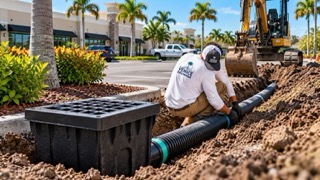
Commercial drainage is not one specific type of drain.
A complete system may use one drainage method or combine several different components depending on how water moves across the property.
Commercial drainage solutions may include:
The goal is simple: collect the water where it is causing a problem and move it where it can properly drain.
Venice Drainage can provide drainage solutions for a wide range of commercial and community properties, including:
Whether the problem is a single low area or water moving across multiple sections of the property, the first step is understanding how the site drains during heavy rainfall.
Commercial properties can experience drainage problems in both landscaped and paved areas.
Common issues include:
A properly designed system addresses both sides of the problem: collection and discharge.
Catch basins are commonly used to collect concentrated surface water from low areas.
They can be installed in landscape areas, grass, parking lot islands, and other locations where stormwater naturally collects.
The basin captures surface water and directs it into underground drainage piping.
If the property has sufficient elevation, that water can often be moved using a gravity drainage system.
The concept is straightforward:
Collection Point → Catch Basin → Underground Pipe → Discharge Point
For many properties, keeping the drainage system simple is the most effective approach.
When the property has enough natural elevation change, gravity can move stormwater through underground drainage pipe without mechanical pumping.
We identify the problem area, establish the available discharge point, and determine whether sufficient fall exists between the two locations.
If the elevations work, underground drainage piping can provide a simple way to move water from Point A to Point B.
Learn more about our yard and gravity drainage systems.
Parking lots create large impervious surfaces where rainfall cannot absorb into the ground.
Instead, water travels across the pavement toward lower areas.
If that runoff isn’t collected effectively, water can accumulate in parking spaces, drive lanes, entrances, pedestrian areas, and landscape islands.
Depending on the property, parking lot drainage may use:
The correct solution depends on how the parking area is graded and where the water can ultimately discharge.
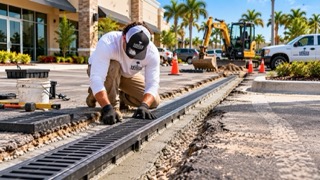
Channel drains are useful when water needs to be intercepted across a wider paved surface.
Instead of collecting water at a single point, the linear drain creates a longer collection area.
Commercial channel drains can be useful around:
Once the water enters the channel, it is directed into underground drainage piping.
Learn more about our deco and channel drain installation.
Not every commercial drainage problem involves visible surface water.
Some properties have landscape areas that remain saturated because water is trapped within the soil.
A French drain can collect subsurface water through perforated drainage pipe surrounded by drainage stone.
Commercial French drains can be useful for:
French drains may also be combined with catch basins when a property has both subsurface water and concentrated surface runoff.
Large commercial roofs can produce significant amounts of runoff during Florida storms.
If downspouts discharge directly beside a building or into landscaping, that concentrated water can contribute to erosion, saturated soil, and standing water.
Underground downspout drainage can capture roof runoff and move it away through dedicated drainage piping.
Downspouts can also be incorporated into a larger commercial stormwater drainage system when appropriate.
Commercial landscaping often contains low areas designed around parking lots, buildings, sidewalks, and drive lanes.
These areas can receive runoff from several surrounding surfaces at once.
Landscape drainage may include catch basins, underground piping, French drains, or other collection systems designed around the site’s elevations.
The finished drainage system can remain largely underground while allowing the landscaped areas to continue functioning normally.
Gravity is generally the simplest way to move water, but not every commercial property has enough elevation to use it.
If the collection area is lower than the available discharge point, a pump may be necessary.
A landscape sump pump system collects stormwater inside an underground basin and mechanically moves it through a discharge line.
Pump systems can be combined with:
We first determine whether gravity drainage is practical before adding mechanical pumping.
A commercial property may receive water from several sources simultaneously.
During a heavy Florida storm, runoff may be coming from:
A commercial stormwater drainage system should consider how all of those areas interact.
Rather than treating every puddle independently, we can look at how water moves across the overall site and determine where it should be collected and discharged.
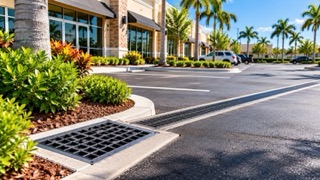
Community properties can have drainage problems that affect common areas, roadways, landscaping, sidewalks, and areas between homes or buildings.
We can evaluate specific problem areas and determine whether the solution requires:
For HOA and condominium projects, the drainage solution can be designed around the specific problem area rather than unnecessarily disturbing the entire property.
Apartment communities and multi-family properties often contain large roofs, parking lots, sidewalks, landscape areas, and multiple buildings within one drainage system.
Low areas can affect residents, parking spaces, walkways, and landscaping.
A site evaluation helps identify where the water originates and whether the existing drainage infrastructure can be improved or supplemented.
Roof runoff is one of the most concentrated sources of stormwater on a commercial property.
Even when the parking lot drains correctly, poorly managed roof water can overwhelm landscape areas around the building.
We can evaluate downspout locations and determine whether roof runoff should be routed into underground drainage piping or incorporated into a larger drainage system.
We begin by identifying where water originates and where it collects.
We look at:
Not every drainage problem requires a large drainage network.
If one catch basin and a gravity-fed pipe can solve the problem, there may be no reason to overcomplicate the system.
If several drainage problems interact, a more comprehensive solution may be appropriate.
We determine where surface or subsurface water should enter the drainage system.
Collected water needs an appropriate place to go.
We evaluate whether water can move by gravity or whether mechanical pumping may be required.
The required catch basins, drainage pipe, French drains, channel drains, or other components are installed based on the system design.
After installation, disturbed landscape areas are restored as appropriate and the majority of the drainage infrastructure remains underground.
Not every project starts from scratch.
Commercial properties may already have drains that no longer manage water effectively.
Problems can result from:
We can evaluate the problem area and determine whether the existing system can be supplemented or whether a different drainage approach is needed.
Persistent standing water can affect more than the appearance of a commercial property.
Drainage problems can interfere with:
Managing stormwater helps keep these areas usable following heavy rainfall.
Commercial drainage costs vary substantially depending on the property and scope of work.
Important factors include:
A focused drainage repair in one landscape area is very different from a drainage project involving a large parking lot or multiple buildings.
An on-site evaluation allows us to determine the appropriate scope before providing a detailed estimate.
Commercial drainage is about more than installing pipe.
The system needs to solve the actual water problem.
Our approach is based on three basic questions:
Where is the water coming from?
Where is it collecting?
Where can we move it?
From there, we determine the simplest drainage system that makes sense for the property.
Venice Drainage installs:
Venice Drainage provides commercial drainage services throughout Venice and surrounding Southwest Florida communities, including:
It depends on where the water originates and how it moves across the property. Commercial systems may use catch basins, gravity drainage, French drains, channel drains, underground piping, pumps, or a combination of several methods.
Yes. Depending on the site’s grading and drainage problem, parking lot drainage may include catch basins, channel drains, trench drains, underground piping, or pumped drainage.
Not always. If there is sufficient elevation between the collection area and discharge point, water may be able to move naturally using gravity. Pumps are typically considered when adequate gravity drainage is not available.
Yes. Drainage solutions can be designed for common areas, landscape areas, areas between buildings, parking areas, and other recurring drainage problems on HOA and condominium properties.
In many situations, roof runoff can be routed through underground drainage piping or incorporated into a larger drainage system. System capacity and discharge conditions need to be considered.
A catch basin collects concentrated surface water from a low area. A French drain collects water from saturated soil through perforated pipe and drainage stone. Some commercial properties benefit from both.
Yes. The appropriate solution depends on why the area remains wet. Catch basins, French drains, gravity drainage, underground piping, or pumped systems may be considered depending on site conditions.
The available discharge route depends on property elevations, existing drainage infrastructure, surrounding conditions, and applicable requirements. This is evaluated as part of planning the drainage system.
Yes. Drainage systems can often be installed or supplemented on existing properties without redesigning the entire site.
Pricing depends on the size and complexity of the drainage problem, required collection points, piping, excavation, hardscape work, discharge route, and whether mechanical pumping is required. An on-site evaluation is the best way to determine the appropriate scope and cost.
If standing water is creating problems around your parking lot, building, landscaping, walkways, or other areas of your property, Venice Drainage can evaluate the site and determine the appropriate solution.
Whether the answer is a simple catch basin and gravity pipe or a larger system involving multiple drainage components, the goal remains the same:
Collect the water. Move it efficiently. Keep the property draining.
Contact Venice Drainage today to schedule an on-site commercial drainage estimate in Venice, Sarasota, Englewood, North Port, or surrounding Southwest Florida communities.