- 509 Cypress Ave, Venice FL 34285
- Mon to Friday: 8:00 am - 6:00 pm
Not every drainage problem requires a complicated system.
Sometimes the solution is simple: collect the water where it is pooling and use gravity to move it from Point A to Point B.
Venice Drainage installs residential yard drainage systems in Venice, FL using catch basins, underground drainage pipe, and the property’s natural elevation to move excess water away from low areas.
If your yard has enough natural fall, a properly installed gravity drainage system can often move water without a pump.
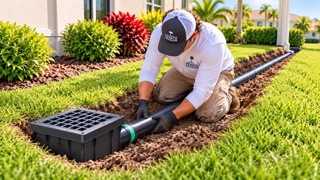
A gravity drainage system uses the natural difference in elevation between two points to move water.
There is no pump pushing the water through the pipe.
Instead, the drainage pipe is installed with enough fall that water naturally travels downhill.
The basic system is simple:
Low Area → Catch Basin → Underground Pipe → Lower Discharge Point
When properly designed, gravity does the work.
Every gravity drainage system starts with two important points.
Point A is where the water is collecting.
Point B is where the water can appropriately discharge.
If Point B is lower than Point A, we may be able to install underground drainage pipe between the two locations and allow gravity to move the water.
During rainfall, surface water enters a catch basin installed in the low area.
The water then travels through the underground pipe toward the lower discharge point.
No pump is required because the elevation change creates the flow.
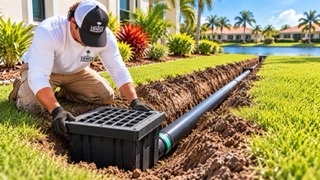
Catch basins are one of the simplest ways to collect standing surface water.
A catch basin is installed at or near the lowest point of the problem area.
The top of the basin has a grate that allows water to enter while helping keep larger debris out of the underground drainage pipe.
The basin then connects directly to solid drainage pipe.
Instead of allowing rainwater to sit in the lawn, the system gives that water a controlled path out of the area.
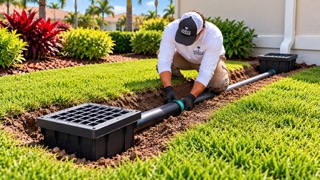
Gravity drainage can be used for many common residential drainage problems throughout Venice and Southwest Florida.
The first step is determining where the water is coming from and whether there is a lower location where it can be moved.
We identify where water is collecting and why that area remains wet.
Elevation is critical.
We determine whether there is enough natural fall between the problem area and a suitable discharge location.
Point A is where we need to collect the water.
Point B is where the water needs to go.
The goal is to create a simple, reliable route between those two points.
A catch basin is positioned in the low area where surface water naturally collects.
Depending on the property, more than one basin may be used.
A trench is excavated between the collection point and discharge location.
Solid drainage pipe is installed with the proper fall so water naturally travels through the system.
The drainage pipe is routed to the appropriate discharge location based on the property and drainage conditions.
Once the system is installed and checked, the trench is backfilled and the disturbed areas can be restored.
After restoration, most of the drainage system is underground. Typically, only the catch basin grates and necessary outlet components remain visible.
A gravity drainage system only works when water has somewhere lower to go.
Simply burying drainage pipe in a yard does not guarantee that water will move.
The pipe needs adequate fall from the collection point toward the discharge point.
That is why checking elevations before installing the system is so important.
If there is enough fall, gravity can provide a simple and reliable drainage solution.
If there isn’t enough fall, another solution may be required.
Whenever practical, we first look at whether the property can drain naturally.
A gravity system does not require a pump to move the water.
However, some Florida properties are simply too flat.
If the available discharge point isn’t lower than the area being drained, water cannot reliably flow uphill through the drainage pipe.
That’s when a landscape sump pump may be needed.
The concept is straightforward:
If we have enough fall, use gravity.
If we don’t have enough fall, we may need a pump.
These systems solve different drainage problems.
A catch basin primarily collects surface water.
A French drain is designed to collect water from saturated soil through a gravel and perforated-pipe drainage system.
If you have a visible puddle forming in a specific low spot, a catch basin and gravity drainage pipe may be appropriate.
If a larger section of the lawn remains saturated and soggy, a French drain may be more appropriate.
Some properties benefit from both.
Downspouts concentrate roof water into relatively small areas around a home.
If roof runoff is contributing to the problem, we may connect the downspouts to an underground downspout drainage system.
That water can then travel underground using gravity toward an appropriate discharge location.
In many cases, downspout drainage and yard drainage can be incorporated into the same overall drainage plan.
Catch basins work well for collecting water from lawns and landscape areas.
Hardscape areas may require a different collection method.
A deco or channel drain creates a long drainage opening that intercepts water moving across surfaces such as:
Once collected, that water can also travel through underground pipe using gravity when sufficient fall is available.
Side yards are one of the most common places for residential drainage problems.
The space between two homes may receive water from roofs, downspouts, landscaping, irrigation, and surrounding lawns.
It can also contain a natural low point between the properties.
A simple side-yard drainage system may use one or more catch basins connected to underground pipe.
The pipe then carries the water toward a lower discharge point.
A low backyard can remain wet long after the rest of the property has dried.
If the backyard sits higher than an available outlet, gravity drainage may provide a straightforward solution.
We can collect water from the lowest portion of the yard and move it underground rather than allowing it to remain on the lawn.
Yes.
A property may have several low areas that need to be addressed.
Depending on the elevations and system design, multiple catch basins can be connected to underground drainage piping.
The important part is keeping the system as simple as the property allows.
We don’t need to add unnecessary drains, pumps, or complicated piping when a straightforward gravity system will solve the problem.
Not necessarily.
If the collection area is higher than the discharge point and there is sufficient fall between them, gravity may move the water without any mechanical equipment.
This is why elevation is one of the first things we consider when evaluating a drainage problem.
Every drainage system needs an appropriate destination for the collected water.
The correct discharge location depends on the individual property, elevations, surrounding conditions, and applicable drainage requirements.
A properly planned system isn’t simply about getting water out of one puddle.
It’s about moving the water to a location where it can discharge appropriately without simply creating another drainage problem.
Yard drainage costs vary because every property has different elevations, distances, access, and drainage conditions.
Factors that affect the cost include:
A simple catch basin and gravity drainage system may cost considerably less than a large drainage project involving French drains, multiple collection points, or pumping equipment.
The best way to determine the correct system and price is to evaluate the property on site.
Drainage doesn’t need to be complicated just for the sake of being complicated.
Our goal is to determine where the water is coming from, where it needs to go, and the simplest reliable way to get it there.
When natural elevation allows us to use gravity, we can design a system around that advantage.
Venice Drainage provides:
Venice Drainage installs residential drainage systems throughout Venice and surrounding Southwest Florida communities, including:
If the property has enough natural slope, one of the simplest solutions is installing a catch basin in the low area and connecting it to underground drainage pipe that carries the water to a lower discharge point.
Gravity drainage moves water through drainage pipe using natural elevation rather than a mechanical pump. The outlet must be sufficiently lower than the collection point for the system to drain properly.
A catch basin collects surface water and directs it into underground drainage pipe. It is commonly installed in low areas where water naturally pools.
No. If there is enough fall between the catch basin and discharge location, the system can drain naturally using gravity.
Yes. Low areas are common locations for catch basins. The more important question is whether there is an appropriate lower location where the collected water can be discharged.
Yes. Side-yard drainage systems commonly use catch basins and underground pipe to collect and redirect water between homes when the elevations allow it.
Depending on the elevations, pipe sizing, expected water volume, and overall system design, multiple catch basins can potentially be incorporated into the same drainage system.
Neither is universally better. Catch basins are generally used to collect concentrated surface water, while French drains collect water from saturated soil. The correct solution depends on the drainage problem.
If there isn’t enough elevation difference between the collection point and the discharge location, a landscape sump pump may be required to mechanically move the collected water.
If water is sitting in your yard after every heavy rain, the solution may be simpler than you think.
We can evaluate the low area, check the elevations, determine where the water can go, and identify whether a standard gravity drainage system can solve the problem.
Point A to Point B. Catch the water, put it underground, and let gravity move it.
Contact Venice Drainage today to schedule an on-site yard drainage estimate in Venice, Sarasota, Englewood, North Port, or surrounding Southwest Florida communities.