


 French Drain
Best Drainage Solutions for Florida Yards: How to Fix Standing Water and Yard Flooding
Standing water is one of the most common landscaping problems for Florida homeowners. After a heavy afternoon storm, you may notice water pooling beside your house, collecting between neighboring homes, flooding landscape beds, or turning sections of your backyard into a soggy mess.
The good news is that there are several effective drainage solutions for Florida yards. The key is choosing the right system for the type of water problem occurring on your property.
French drains, catch basins, underground downspout extensions, channel drains, landscape sump pumps, grading, and swales can all be effective—but they solve different problems.
In many cases, the best yard drainage system isn’t one individual drain. It is a combination of drainage components designed around how water actually moves across the property.
Why Do Florida Yards Have So Many Drainage Problems?
Florida’s climate and relatively flat terrain create challenging conditions for residential drainage.
A yard may look perfectly fine during dry weather and then develop significant standing water during the rainy season.
Some of the most common causes include:
- Heavy rainfall
- Flat or improperly graded yards
- Low areas between homes
- Roof and downspout runoff
- Saturated soil
- High groundwater conditions
- Runoff from neighboring properties
- Pool decks and patios
- Paver driveways and walkways
- Landscape beds and curbing that block water flow
- Insufficient existing stormwater drainage
The location of the puddle doesn’t always identify the source of the problem. Water may originate from the roof, flow across another portion of the property, or move through saturated soil before finally collecting in the lowest part of the yard.
That’s why fixing drainage starts with understanding where the water is coming from and where it can safely go.
What Is the Best Drainage Solution for a Florida Yard?
There isn’t one drainage system that works best for every Florida property.
The correct solution depends primarily on the type of water you’re trying to manage.
| Drainage Problem | Potential Solution |
|---|---|
| Saturated or soggy soil | French drain |
| Large surface puddles | Catch basin / yard drain |
| Roof runoff | Underground downspout drainage |
| Water crossing a driveway or patio | Channel or deco drain |
| Low yard with no gravity outlet | Landscape sump pump |
| Minor elevation problems | Grading |
| Large areas of overland runoff | Swale |
| Multiple water problems | Combination drainage system |
Let’s look at each option in more detail.
1. French Drains
A French drain is one of the most recognized yard drainage solutions, but it is often misunderstood.
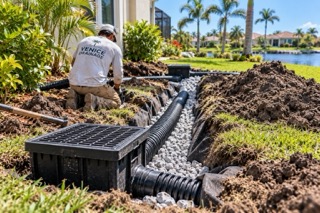
A typical French drain consists of:
- An excavated trench
- Drainage filter fabric
- Clean drainage stone
- Perforated drainage pipe
Water enters through the surrounding stone and perforations in the pipe. The pipe then carries the collected water toward an appropriate discharge point.
When Is a French Drain a Good Choice?
French drains are particularly useful when the problem involves saturated soil or subsurface water.
They may be appropriate for:
- Soggy side yards
- Persistently wet lawn areas
- Water collecting along landscape beds
- Low areas that remain saturated after storms
- Drainage along portions of a home’s perimeter
A French drain is not automatically the best solution for large amounts of fast-moving surface water. In those situations, catch basins or other surface drainage components may also be necessary.
Do French Drains Work in Florida?
Yes. Properly designed French drains can work very well in Florida.
However, the system still needs somewhere to send the collected water. Florida’s flat terrain can make the discharge side of the drainage design just as important as the French drain itself.
Depending on the property, water may be moved through gravity-fed solid pipe or, when sufficient elevation isn’t available, through a landscape sump-pump system.
2. Catch Basins and Yard Drains
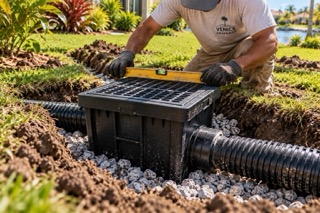
When water is visibly pooling on the surface of the lawn, a catch basin can provide a direct entry point into an underground drainage system.
A catch basin is typically installed at or near a low point in the yard. Water enters through the grate and is transported through drainage pipe to an appropriate outlet.
Catch Basins Are Best for Surface Water
Think of a catch basin as a floor drain for your yard.
If a large puddle consistently forms in the same low spot during heavy rain, installing a surface drain at that location can allow the water to enter the drainage system much faster than waiting for it to soak into the soil.
Catch basins are commonly used in:
- Backyards
- Side yards
- Landscape areas
- Low lawn areas
- Near patios
- Areas receiving significant stormwater runoff
French Drain vs. Catch Basin
The simplest distinction is this:
A French drain primarily collects water from the surrounding soil. A catch basin primarily collects water from the surface.
Many Florida yards experience both problems.
For example, a low side yard might develop a large puddle during a thunderstorm and then remain soggy for several days afterward.
In that situation, a combination of catch basins and French drainage may provide a more complete solution than either system by itself.
3. Underground Downspout Drainage
One of the first things to evaluate when diagnosing a wet Florida yard is the roof.
A roof collects a large volume of rainfall and concentrates that water into a relatively small number of downspouts.
If those downspouts empty directly beside the home, thousands of gallons of water can be discharged into the same areas of the property over the course of Florida’s rainy season.
How Underground Downspout Drainage Works
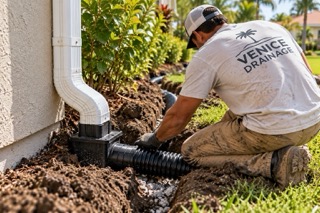
The downspout is connected to a drainage adapter and solid underground pipe.
Instead of dumping roof water onto the lawn beside the house, the system carries it toward a more appropriate discharge location.
This can be especially helpful for:
- Narrow side yards
- Areas between neighboring homes
- Landscape beds beside the house
- Downspouts that create erosion
- Areas where roof runoff contributes to standing water
Should Downspouts Connect to a French Drain?
Roof runoff and groundwater are different types of water and should be considered carefully when designing a system.
Downspouts produce concentrated flows during storms. A French drain is designed to collect water gradually from surrounding soil.
A drainage contractor may design the system so roof water travels through solid pipe while the French drain uses perforated pipe, with the systems ultimately connecting or discharging appropriately based on the property.
4. Channel Drains and Deco Drains
Grass isn’t the only place where drainage problems occur.
Water can also collect on:
- Paver driveways
- Concrete driveways
- Pool decks
- Patios
- Walkways
- Garage entrances
- Outdoor living areas
In these situations, a linear surface drainage system such as a channel drain or deco drain may be more appropriate.
How Channel Drains Work
A channel drain creates a long, narrow collection point across the surface.
Instead of allowing water to continue flowing across a driveway or patio, the drain intercepts the runoff and directs it into underground drainage pipe.
Where Are Channel Drains Most Useful?
They are particularly useful where water moves across hard surfaces rather than soaking into soil.
A channel drain may be installed:
- Across the bottom of a sloped driveway
- Near a garage entrance
- Along a pool deck
- Between a patio and lawn
- Across a walkway
5. Landscape Sump Pumps
One of the biggest challenges with Florida yard drainage is elevation.
Drainage systems that rely on gravity need enough fall between the collection area and the discharge point.
But many properties in Venice, Sarasota, Nokomis, Englewood, North Port, and surrounding Southwest Florida communities are relatively flat.
Sometimes the low point that needs drainage is actually lower than the practical discharge location.
That’s where a landscape sump pump can become useful.
How a Landscape Sump Pump Works
Water is collected in an underground basin. When the water reaches a predetermined level, a pump activates and moves the water through a discharge line.
The pump essentially provides the elevation change that gravity cannot.
When Might a Yard Need a Sump Pump?
A landscape sump pump may be considered when:
- The property is extremely flat
- The backyard is lower than the front
- Gravity drainage cannot reach a suitable outlet
- A pool or hardscape creates a trapped low area
- Large amounts of water repeatedly collect in the same area
A sump pump should not be added automatically. If gravity drainage is practical, a passive system may be simpler. The elevations of the property should be evaluated first.
6. Yard Grading
Sometimes the problem isn’t a lack of drainage pipe. It’s the shape of the yard.
Grading means adjusting soil elevations so water naturally flows in the desired direction.
A relatively small low area may sometimes be corrected by reshaping the landscape rather than installing an extensive underground drainage system.
When Does Grading Work Best?
Grading is most effective when:
- There is an obvious low spot
- A suitable lower area exists nearby
- Water can safely flow over the surface
- The elevation can be changed without negatively affecting neighboring properties or structures
Grading can also be combined with underground drainage.
7. Drainage Swales
A swale is a shallow, graded depression designed to move surface water across a property.
Unlike a buried drainage pipe, a swale manages water above ground.
Swales can be very effective for moving stormwater across larger areas when sufficient elevation is available.
Benefits of Swales
- No underground pipe required in some applications
- Can move large amounts of surface runoff
- Relatively simple design
- Can be incorporated into landscaping
However, swales require adequate space and elevation. They may not be practical in narrow side yards or highly developed properties.
8. Dry Wells
A dry well is an underground structure intended to temporarily collect water and allow it to infiltrate into the surrounding soil.
Dry wells can work in certain conditions, but they are not automatically a good solution for every Florida yard.
If the surrounding soil is already saturated or groundwater conditions are high, there may be limited capacity for additional water to infiltrate.
For that reason, soil conditions and site characteristics should be evaluated before relying on infiltration as the primary drainage strategy.
9. Combination Yard Drainage Systems
For many Florida properties, this is the most important solution on the list.
Real-world drainage problems don’t always fit neatly into one category.
A property might have:
- Roof water entering the side yard
- Saturated soil beside the house
- A low spot in the backyard
- A patio shedding surface runoff
- Insufficient elevation for gravity drainage
Installing one French drain may address only one piece of that problem.
A complete drainage design might instead include:
- Underground downspout connections
- French drainage
- Multiple catch basins
- Solid drainage pipe
- A channel drain
- A sump basin and pump
The objective isn’t to install as many drains as possible. It’s to use the correct components to collect, transport, and discharge water efficiently.
How to Fix Standing Water in a Florida Yard
If you repeatedly have standing water in your yard, start by observing what happens during a heavy rainstorm.
Look for:
- Where does the water first appear?
- Which direction is surface water moving?
- Where do the downspouts discharge?
- Is water coming from a neighboring property?
- Does the puddle disappear quickly after rain?
- Does the soil stay saturated for several days?
- Is the problem limited to grass or also affecting hard surfaces?
- Is there an obvious lower area where water could go?
These observations can provide important clues.
If Water Appears Quickly During Rain
You may be dealing primarily with surface runoff.
Potential solutions include catch basins, grading, swales, channel drains, or downspout drainage.
If the Yard Stays Soggy for Days
Subsurface drainage may be a larger part of the problem.
A French drain may help collect water from saturated soil and transport it elsewhere.
If Water Collects Beside Downspouts
Roof drainage should be evaluated before installing a larger yard drainage system.
If There Is Nowhere for the Water to Go
A landscape sump-pump system may be worth considering if the elevations do not support gravity drainage.
How Do You Drain Water Away From a House in Florida?
Water near a home can come from several sources, so there isn’t one universal solution.
Potential strategies include:
- Extending downspouts underground
- Improving grading around the home
- Installing French drainage in persistently saturated areas
- Adding catch basins to collect surface runoff
- Using solid drainage pipe to transport collected water
The drainage system should move water toward an appropriate location without simply creating a new drainage problem elsewhere.
What Is the Best Drainage Solution for a Side Yard?
Narrow side yards are particularly challenging in Florida.
They frequently contain air-conditioning equipment, utility lines, fences, landscape beds, and multiple downspouts while also having limited elevation change.
Depending on the cause of the problem, a side-yard drainage system might include:
- A French drain
- Catch basins
- Underground downspout extensions
- Solid drainage pipe
- Grading
- A landscape sump pump
The available width and elevation of the side yard are important factors when designing the system.
How Much Does Yard Drainage Cost in Florida?
The cost of a yard drainage system depends heavily on the solution being installed.
A simple downspout extension is very different from a complete drainage system involving excavation, French drains, multiple catch basins, underground pipe, and a landscape sump pump.
As broad planning ranges, residential drainage projects may look something like:
| Project Type | General Planning Range |
|---|---|
| Small drainage correction | $1,000–$2,500+ |
| French drain / side-yard drainage | $2,500–$5,000+ |
| Multi-component yard drainage | $5,000–$10,000+ |
| Complex drainage with pumps or multiple systems | $7,500–$15,000+ |
These are general planning ranges rather than quotes. Actual pricing depends on the property, excavation, access, materials, system size, discharge requirements, restoration, and overall drainage design.
Can You Fix Yard Drainage Yourself?
Some minor drainage problems can be addressed by homeowners, especially simple issues such as extending a downspout farther from a problem area.
More complicated drainage projects require careful planning.
Common DIY drainage mistakes include:
- Installing pipe without enough slope
- Using perforated pipe where solid pipe is needed
- Using solid pipe where subsurface collection is needed
- Installing catch basins above the actual low point
- Failing to use proper filter fabric
- Using insufficient drainage stone
- Ignoring roof runoff
- Failing to consider property elevations
- Sending water toward a neighboring property
- Installing a drain with no practical discharge point
The last mistake is particularly important.
Collecting water is only half of a drainage system. You also need a plan for where that water will go.
How to Choose the Right Yard Drainage Contractor
A drainage contractor should do more than recommend a drain based on where a puddle is located.
A proper evaluation should consider:
- Property elevations
- Roof runoff
- Existing gutters and downspouts
- Low areas
- Surface runoff patterns
- Soil saturation
- Hardscaping
- Neighboring runoff
- Available discharge locations
- Access for installation
Before moving forward with a drainage project, you should understand why the recommended system is expected to solve the problem.
Yard Drainage Solutions in Venice, Sarasota and Southwest Florida
Venice Drainage provides residential and commercial drainage solutions throughout Venice, Sarasota, and surrounding Southwest Florida communities.
Our drainage services include:
- French drain installation
- Catch basins and yard drains
- Downspout drainage
- Landscape sump pumps
- Side-yard drainage
- Yard flooding solutions
- Channel drains
- Deco drains
- Stormwater management
- Commercial drainage solutions
We serve properties throughout Venice, South Venice, Venice Island, Nokomis, Osprey, Sarasota, Wellen Park, East Venice, Englewood, North Port and surrounding areas.
Get a Yard Drainage Estimate
If you’re dealing with standing water, a soggy lawn, side-yard flooding, downspout runoff, or recurring drainage problems, the first step is identifying why the water is collecting.
Venice Drainage can evaluate the property, identify potential drainage issues, and recommend a system based on the site’s actual conditions.
The solution may be a French drain. It may be catch basins. It may be underground downspout drainage, a landscape sump pump, or a combination of several systems.
Contact Venice Drainage to schedule an on-site yard drainage estimate in Southwest Florida.
Frequently Asked Questions About Florida Yard Drainage
What is the best drainage system for a Florida yard?
There isn’t one system that is best for every property. French drains are useful for saturated soil, catch basins collect surface water, underground downspout systems manage roof runoff, channel drains intercept water on hard surfaces, and sump pumps can move water when gravity drainage isn’t possible.
What is the best way to fix standing water in a yard?
The solution depends on why the water is standing. Surface puddles may require catch basins or grading, while persistently saturated soil may benefit from French drainage. Roof runoff and property elevations should also be evaluated.
Are French drains good for Florida?
Yes. French drains can be effective in Florida when they are correctly designed and have an appropriate way to discharge the collected water.
Will a French drain fix a flooded backyard?
Possibly, but not every flooded yard needs a French drain. If most of the problem comes from fast-moving surface runoff, catch basins, grading, or other surface drainage solutions may be more appropriate. Some properties benefit from a combination system.
How do you drain a flat Florida yard?
A flat property may use catch basins, French drains, solid drainage pipe, grading, or a combination of systems. If there isn’t enough elevation for gravity drainage, a landscape sump pump may be considered.
How do I stop water from pooling between houses?
First determine whether the water is coming from roof downspouts, surface runoff, saturated soil, or a combination of sources. Common side-yard solutions include underground downspout extensions, French drains, catch basins, grading, and sump pumps.
Should I use solid or perforated drainage pipe?
It depends on the purpose of the pipe. Perforated pipe is commonly used where the system needs to collect water from surrounding soil. Solid pipe is commonly used to transport water that has already been collected, such as roof runoff from downspouts.
Can a catch basin connect to a French drain?
Catch basins and French drains can be incorporated into the same overall drainage design when a property experiences both surface runoff and saturated soil. The exact configuration should be based on elevations, flow, and the intended discharge location.
Do I need a sump pump for my yard?
A landscape sump pump may be useful when water collects in a low area and there isn’t enough natural elevation to move it to an appropriate outlet using gravity.
How much does yard drainage cost in Florida?
Small drainage corrections may cost around $1,000–$2,500+, while typical residential drainage projects may fall around $2,500–$5,000+. Larger multi-component systems can reach $5,000–$10,000+, and complex systems involving pumps or extensive drainage infrastructure may exceed that range.
Bottom Line: Solve the Water Problem, Not Just the Puddle
The best drainage solution for a Florida yard depends on the source of the water, how it moves across the property, and where it can safely go.
A French drain may be perfect for saturated soil but ineffective at quickly collecting a large volume of surface runoff. A catch basin can collect a puddle but won’t necessarily solve surrounding saturated soil. Underground downspout drainage can eliminate concentrated roof runoff but won’t correct every low area in a yard.
That’s why effective drainage often requires looking at the property as one complete system.
Identify where the water comes from. Determine how to collect it. Create a way to transport it. Then make sure it has an appropriate place to go.
For homeowners and property owners throughout Venice, Sarasota, and Southwest Florida, Venice Drainage provides on-site drainage evaluations and professionally installed solutions for standing water, yard flooding, roof runoff, and difficult drainage problems.
