- 509 Cypress Ave, Venice FL 34285
- Mon to Friday: 8:00 am - 6:00 pm
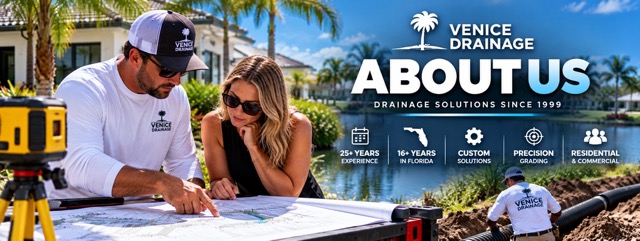
Our contracting and drainage experience dates back to 1999. Long before Venice Drainage was established in Florida, we were dealing with grading, runoff, construction and drainage problems as contractors in California.
That experience taught us something that continues to shape the way we approach drainage today:
Many drainage problems are created long before the first puddle appears.
When drainage isn't considered during the original construction, grading, landscaping or improvement of a property, the problem may not become obvious until heavy rainfall reveals exactly where that water wants to go.
After more than 16 years in Florida, we've learned that Southwest Florida presents an entirely different set of drainage challenges.
Florida can receive tremendous amounts of rainfall in a short period of time. When that happens, the challenge isn't simply dealing with a wet area — it can become a question of how quickly that water can be collected and evacuated from the property.
Flat properties, saturated ground, large roofs, gutters, pool decks, paver driveways, neighboring runoff and limited elevation change can all contribute to drainage problems.
We've taken decades of construction and drainage experience and adapted that knowledge to the conditions we encounter here in Florida, providing practical drainage solutions for homeowners, businesses and commercial properties throughout Venice and surrounding Southwest Florida communities.
Every property is unique, and so is the drainage solution it may require.
One property may need a simple catch basin connected to an underground gravity line. Another may need underground downspout drainage to control concentrated roof runoff.
A saturated area may benefit from a French drain. A driveway or pool deck may need a channel drain. A flat backyard without an appropriate gravity discharge may require a landscape sump pump.
Some properties require several drainage components working together as one system.
That's why we don't begin with the question, "What type of drain should we install?"
We begin with a much more important question:
What is the water doing?
We approach drainage by answering a few fundamental questions:
Answering those questions helps us determine a practical drainage solution based on the actual conditions of the property.
Positive gravity drainage depends on elevation.
Water flows downhill, which means determining the actual elevations across a property can be an important part of designing a drainage system.
We use laser leveling technology when appropriate to measure elevations and determine the available grade change between collection areas, proposed drainage routes and potential discharge locations.
The objective is to make drainage decisions based on measurable site conditions rather than simply guessing what the yard appears to be doing.
Have a new drainage problem? Tell us what's happening and let our team help determine the appropriate next step.

Collecting water is only one part of a properly planned drainage system.
The system also needs enough capacity to move the expected volume of water away from the problem area.
Pipe diameter matters because increasing diameter dramatically increases the available cross-sectional flow area.
A 6-inch diameter pipe has approximately 2.25 times the cross-sectional area of a 4-inch diameter pipe.
However, diameter isn't the only factor that determines how much water a gravity drainage line can convey.
Actual conveyance is influenced by factors including:
Advanced Drainage Systems (ADS), a major manufacturer of corrugated HDPE drainage pipe, publishes hydraulic data for its drainage products using pipe diameter, roughness and slope to determine conveyance.
That's why we believe drainage capacity should be considered as part of the entire system design rather than simply choosing a pipe because it is commonly used.
A drainage line may be responsible for much more than the rainfall landing directly on the lawn above it.
Depending on the property, we may need to consider:
How much water may enter the system — and how efficiently can we get it out?
A roof acts as a large collection surface.
Rainfall landing across hundreds or thousands of square feet of roof is collected by the gutter system and concentrated into a relatively small number of downspouts.
This is why roof size, gutter configuration, downspout quantity and downspout locations can be important when evaluating drainage around a home.
Learn More About Downspout Drainage →
Florida pool areas introduce additional drainage considerations.
Pool decks create hard surfaces that shed rainfall. Screen enclosures and super gutters can concentrate additional runoff into specific locations.
Deco drains and channel drains may also collect water from large portions of a pool deck.
When these sources ultimately connect to underground drainage, their contribution should be considered as part of the overall system.
A drainage problem doesn't necessarily originate on the property where the water is collecting.
Water follows elevation.
If surrounding properties are higher, stormwater may naturally move toward a lower property. Understanding surrounding elevations and external sources of runoff can therefore be an important part of identifying the actual drainage problem.
A catch basin can collect concentrated surface runoff.
A channel or deco drain can intercept water moving across a paved surface.
Downspout drainage can control concentrated roof runoff.
A French drain can help collect water from saturated soil.
A landscape sump pump can move collected water when sufficient gravity drainage isn't available.
A gravity drainage system may provide a simple solution when adequate elevation exists.
Experience has also taught us not to unnecessarily complicate drainage.
Some properties require multiple collection points, larger piping or several drainage methods working together.
Other properties may simply require:
Point A → Underground Pipe → Point B.
Our objective isn't to install the greatest number of drainage components.
Our objective is to determine the drainage solution the property actually requires.

Some of the most difficult drainage problems we encounter could have been easier to address if water movement had been considered before the property was finished.
Construction and property improvements can introduce:
Each can change how water moves across a property.
Installing underground drainage before landscaping, sod, pavers and other finished improvements are completed can provide more options and reduce the amount of finished work that may need to be disturbed later.
Learn About New Construction Drainage →
Venice Drainage provides custom drainage solutions for residential and commercial properties throughout Venice and surrounding Southwest Florida communities.
Explore All Drainage Services →
Learn About Commercial Drainage →
Drainage makes more sense when you can see the actual property, understand the problem and see why a particular solution was selected.
We're building a collection of real drainage projects showing the conditions we encountered, the challenges presented by each property and the drainage systems used to address them.
Our project pages will show:
Venice Drainage provides residential and commercial drainage solutions throughout Venice and surrounding Southwest Florida communities, including:
Venice • South Venice • Venice Island • East Venice • Wellen Park • Nokomis • Osprey • Sarasota • Englewood • North Port
After decades of contracting and drainage experience, one principle continues to guide the way we approach these projects:
Understand the water before designing the drainage system.
We look at where the water originates, where it collects, property elevations, potential runoff sources, available grade, the capacity required and where the water can appropriately go.
Then we determine the drainage solution.
If you're dealing with standing water, yard flooding, roof runoff, paver washout or another drainage problem, you don't need to determine whether you need a French drain, catch basin, sump pump or another system before contacting us.
Show us the problem. We'll help determine the solution.
If you're considering a new drainage project, tell us about the property and the problem you're experiencing. If you're already a Venice Drainage customer, use our Support page so we can properly route your request.